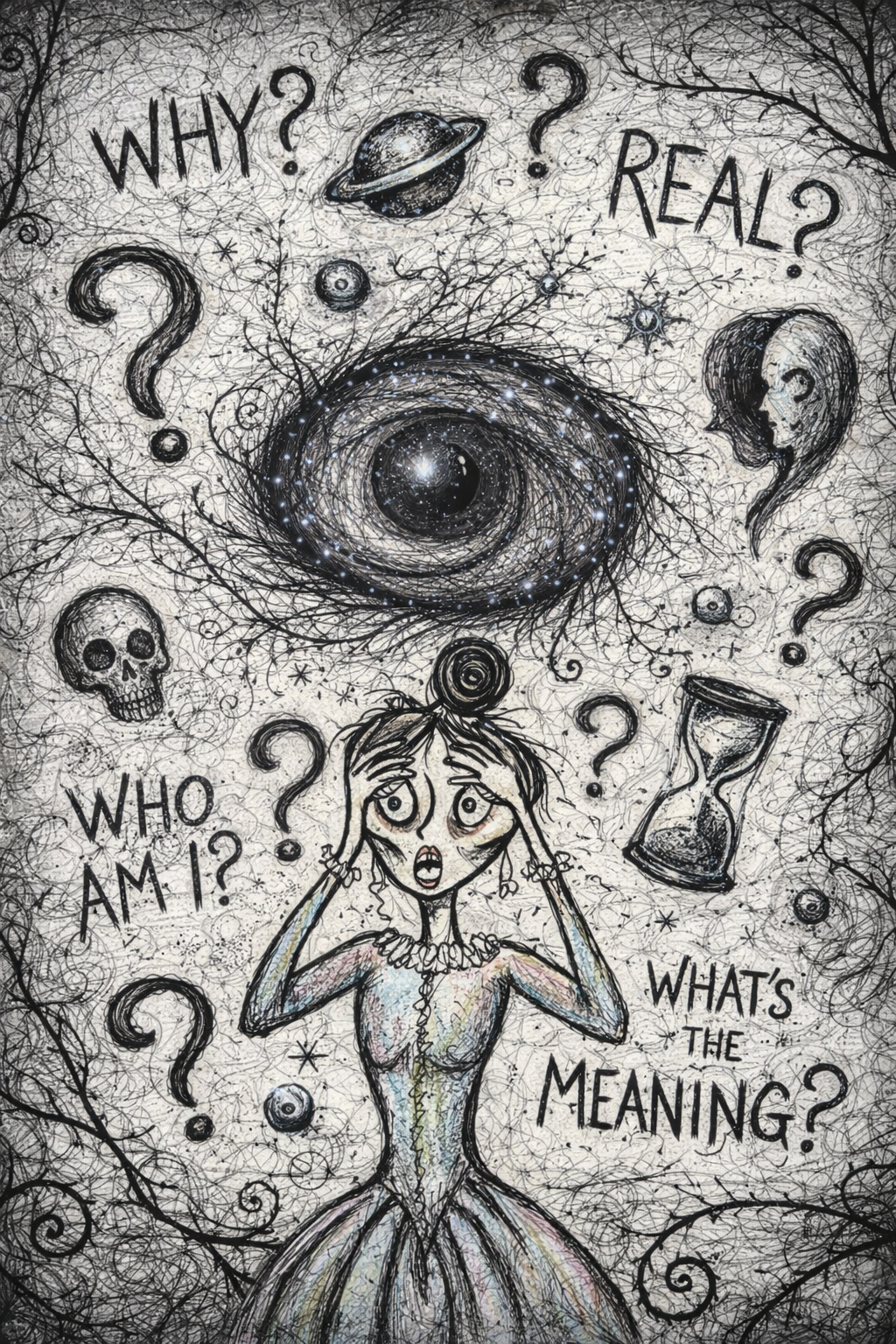
Do you find yourself stuck in loops of philosophical questions and intrusive existential thoughts that never seem to resolve? This could be a sign of existential OCD.
You may spend hours asking yourself things like:
• What if reality isn’t real?
• What if nothing truly matters?
• What if I suddenly lose my sense of self or awareness?
• What if life has no meaning and everything is pointless?
For people struggling with existential OCD, these thoughts are not simply philosophical curiosity. They feel urgent, frightening, and impossible to ignore.
If you are searching for existential OCD treatment, you may already know how exhausting these mental loops can become. The mind constantly tries to solve questions that cannot be solved with certainty.
You may notice yourself:
• Replaying the same questions over and over
• Googling philosophical explanations for hours
• Seeking reassurance from others about reality or meaning
• Trying to “figure it out” until it finally feels right
But instead of relief, the questioning only grows stronger.
Many people with existential obsessive-compulsive disorder feel as though their mind is caught in an endless philosophical maze. The more they search for certainty, the further away peace seems to move.
The good news is that existential OCD treatment using evidence-based therapy can help you step out of these loops and reconnect with life again.
Existential OCD Is More Common Than People Realize
Many people assume that intrusive existential thoughts are a sign of deep philosophical insight or intellectual curiosity.
In reality, existential OCD is a recognized subtype of obsessive-compulsive disorder.
It occurs when the brain becomes stuck on questions about:
• reality
• consciousness
• existence
• identity
• the meaning of life
• whether anything is truly real
While these topics can naturally arise in philosophy, existential OCD turns them into intrusive obsessions.
Instead of curiosity, people experience:
• intense anxiety
• mental checking
• endless rumination
• attempts to “solve” unanswerable questions
For example, someone might think:
“What if everything is just a simulation?”
Most people would dismiss the thought and move on.
But with existential OCD, the mind treats the question like an emergency that must be solved immediately.
The brain begins searching for certainty:
Is this real? What if it’s not? What if I never know?
Hours of mental debate may follow.
Ironically, the more someone tries to find certainty, the more powerful the obsession becomes.
This is because OCD feeds on the search for absolute answers.
The good news is that existential OCD treatment can teach you how to stop feeding these loops and regain mental freedom.
How Existential OCD Treatment Can Help You Break the Thought Loop
Effective existential OCD treatment focuses on helping you respond differently to intrusive thoughts rather than trying to eliminate them.
In my practice, I primarily use Cognitive Behavioral Therapy (CBT) and Exposure and Response Prevention (ERP), the gold-standard treatments for OCD.
These approaches help clients:
• understand how OCD works
• recognize intrusive thoughts as mental events rather than threats
• stop engaging in compulsive rumination
• tolerate uncertainty about existential questions
Understanding the OCD Cycle
With existential obsessive-compulsive disorder, the cycle often looks like this:
- An intrusive thought appears
- Anxiety spikes
- The mind begins analyzing the thought
- Rumination temporarily reduces anxiety
- The brain learns that rumination is necessary
Unfortunately, rumination is actually a compulsion.
Just like hand-washing in contamination OCD, mental analysis keeps the disorder alive.
Exposure and Response Prevention for Existential OCD
Exposure and Response Prevention (ERP) helps break this cycle.
In ERP for existential OCD, you gradually learn to:
• allow existential thoughts to exist without solving them
• resist the urge to analyze or debate the thought
• tolerate uncertainty about reality or meaning
• redirect attention back to living your life
Over time, the brain learns something important:
The thought itself is not dangerous.
When the mind stops treating these thoughts like emergencies, the anxiety slowly loses its grip.
Cognitive Strategies That Support Existential OCD Treatment
Alongside ERP, CBT tools help clients challenge the beliefs that fuel existential rumination.
For example:
• Thought-action fusion: believing thinking about reality means something must be wrong
• Intolerance of uncertainty: needing absolute answers about existence
• Overimportance of thoughts: assuming thoughts must be solved
Learning to recognize these patterns can dramatically weaken the OCD cycle.
My Experience Treating Existential OCD
I specialize in OCD and anxiety disorders, including existential OCD, harm OCD, contamination OCD, and relationship OCD.
I received advanced training in treating OCD through the Beck Institute for Cognitive Behavioral Therapy, one of the leading CBT training organizations in the world.
I am also a memberhttps://iocdf.org/ of the International OCD Foundation (IOCDF).
\
In addition to clinical work, I am the author of:
Quieting the Noise: An Illustrated Guide to Living with OCD
This book was designed to help people understand the internal experience of OCD and learn practical strategies for breaking free from obsessive loops.
In therapy sessions, my goal is to create a structured and compassionate environment where clients can learn practical tools to manage OCD.
Together, we focus on building the skills necessary to respond differently to intrusive thoughts so that life can become larger than the disorder.
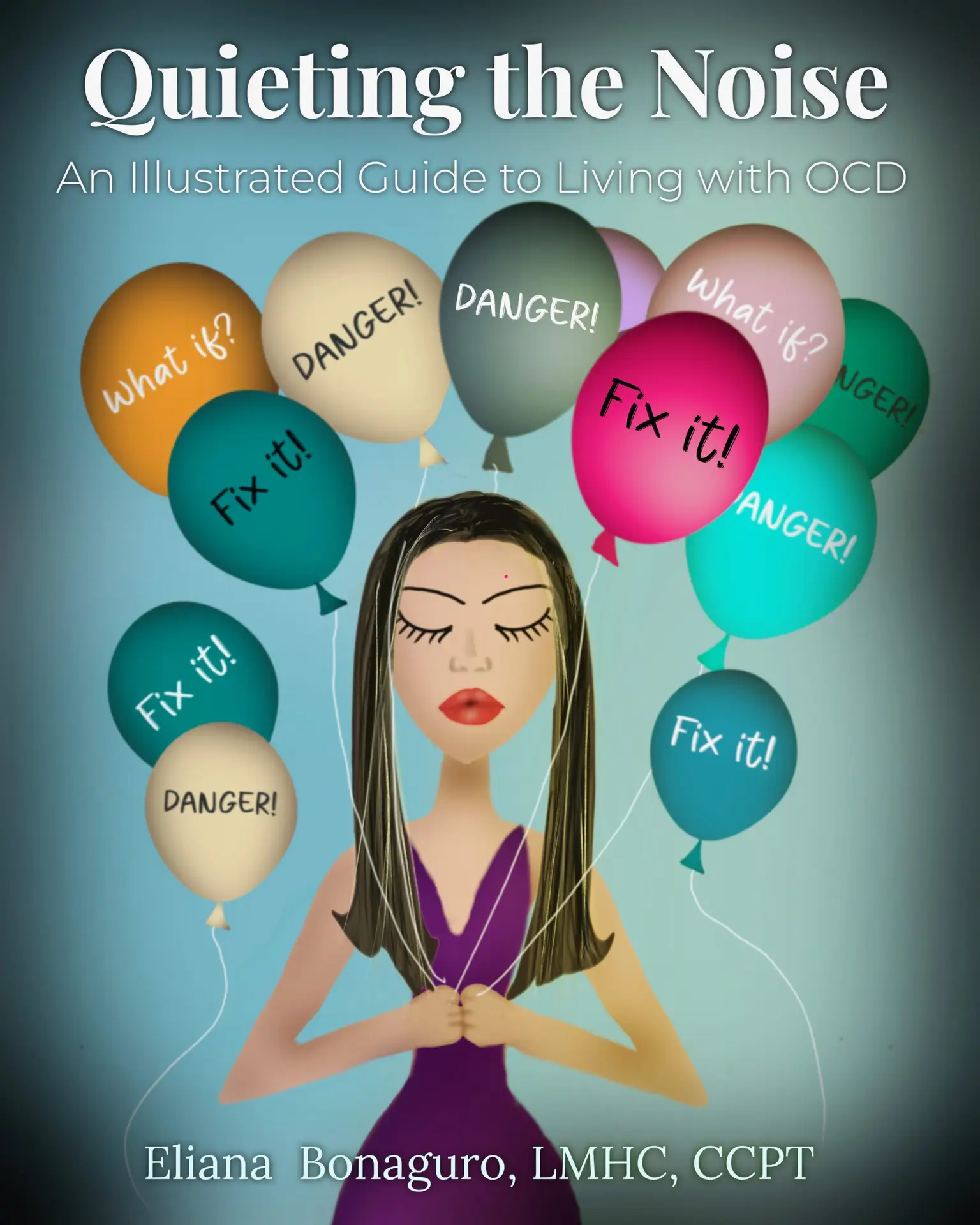
Author of the book Quieting the noise: an Illustrated Guide to Living with OCD. Avaialble on Amazon
But You May Still Have Questions About Existential OCD Treatment
What if these thoughts mean something is actually wrong with me?
Many people with existential OCD fear that their thoughts indicate a deeper psychological or philosophical problem.
In reality, intrusive existential questions are a common OCD symptom. Therapy focuses on changing how you respond to these thoughts rather than trying to eliminate them entirely.
What if therapy makes the thoughts worse?
ERP can initially feel uncomfortable because it asks you to stop engaging in rumination.
However, this discomfort is temporary and purposeful. Over time, learning to allow uncertainty actually reduces the power these thoughts hold over you.
What if I’ve been stuck in these thoughts for years?
OCD can persist for many years without the right treatment. The encouraging news is that ERP and CBT remain effective even when OCD has been present for a long time.
Many people experience meaningful improvement once they begin structured OCD therapy.
You Don’t Have to Live in Endless Philosophical Loops
Existential questions are part of being human.
But existential OCD turns those questions into mental traps that make it difficult to fully engage with life.
If you are struggling with constant rumination about reality, meaning, or existence, existential OCD treatment can help you step out of the loop and regain mental space.
With the right tools, it becomes possible to:
• allow thoughts to come and go without analyzing them
• tolerate uncertainty about philosophical questions
• reduce the anxiety attached to intrusive thoughts
• reconnect with the present moment
If you would like to learn more about existential OCD treatment, you are welcome to reach out.
If you’re looking for existential OCD treatment in NYC
existential OCD treatment in New York and Florida, I offer specialized therapy using CBT and Exposure and Response Prevention (ERP)
Together, we can work toward quieting the noise so that your life is no longer organized around intrusive thoughts.