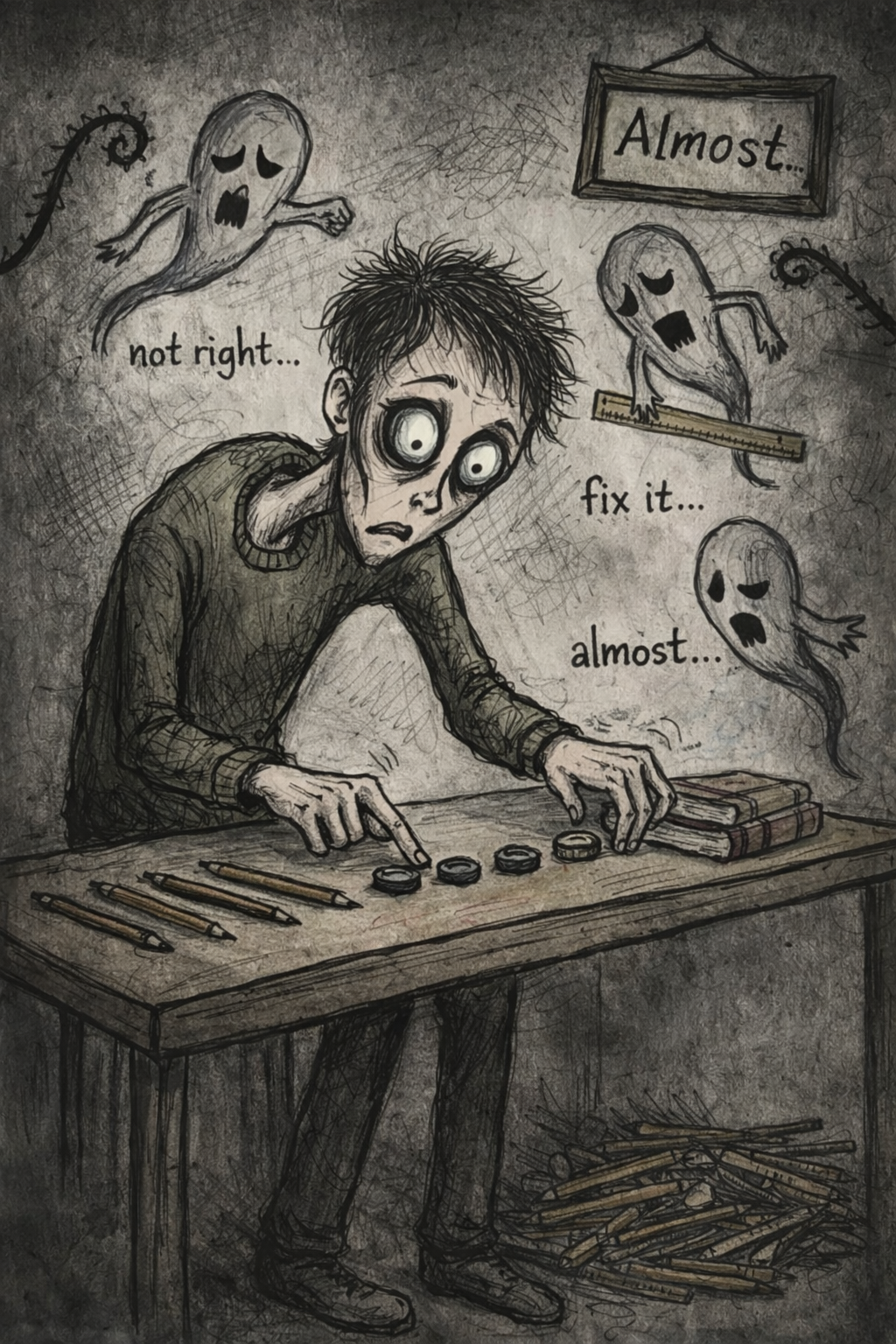
If you struggle with Just Right OCD, everyday activities can become surprisingly difficult. A small detail may feel slightly off, uneven, or incomplete, and the discomfort can be intense until it is corrected.
People with Just Right OCD often repeat actions until things feel perfect, balanced, or mentally settled. The distress does not always come from a fear that something bad will happen. Instead, it comes from a powerful internal sensation that something simply isn’t right.
You might find yourself adjusting objects, repeating movements, rereading messages, or rewriting sentences until they feel correct. Even though you may recognize that the behavior is excessive, the urge to fix the feeling can be overwhelming.
Over time, Just Right OCD can consume hours of the day, making ordinary tasks exhausting.
The encouraging news is that Just Right OCD is highly treatable, and many people experience significant improvement with evidence-based treatment such as Exposure and Response Prevention (ERP).
What Is Just Right OCD?
Just Right OCD is a subtype of obsessive-compulsive disorder in which a person feels compelled to repeat behaviors until something feels correct, symmetrical, balanced, or complete.
Unlike contamination OCD or harm OCD, which revolve around specific fears, Just Right OCD is usually driven by an internal sensation of discomfort or incompleteness.
People often describe the experience as a nagging feeling that something is wrong.
Common examples include:
- Adjusting objects until they appear perfectly aligned
- Repeating physical movements until they feel correct
- Rewriting text or rereading sentences multiple times
- Repeating routines until they feel finished
- Adjusting clothing, posture, or body movements until they feel balanced
This subtype is sometimes called symmetry OCD, perfectionism OCD, or “not just right” OCD.
However, it is much more than a preference for neatness. The urge to correct the feeling is driven by anxiety and can become compulsive.
The “Not Just Right” Feeling in Just Right OCD
One of the most distinctive aspects of Just Right OCD is the uncomfortable sensation people experience when something feels wrong.
Many individuals describe:
- A physical tension or pressure
- A sense of internal imbalance
- A mental itch that needs to be resolved
- A feeling of incompleteness
Until the action is repeated or corrected, the discomfort may persist.
For example:
Someone might adjust a picture frame several times until it feels symmetrical. Another person may reread an email repeatedly because the wording does not feel right. Someone else may repeat a physical movement until the motion feels “even.”
The relief after correcting the behavior is usually temporary. Soon, the feeling returns, restarting the cycle.
Why Just Right OCD Develops
Several cognitive and behavioral patterns contribute to Just Right OCD.
Sensory Discomfort
Many people with Just Right OCD experience a strong internal sensation that something is off or incomplete.
Perfectionistic Thinking
The mind may demand precision or exactness before a task feels acceptable.
Intolerance of Imperfection
Small imperfections may feel deeply uncomfortable and difficult to ignore.
Reinforcement Through Relief
When the person performs the ritual and the discomfort fades, the brain learns that the ritual worked. This reinforces the behavior.
Over time, the brain becomes trained to repeat these behaviors automatically.
How Just Right OCD Affects Daily Life
Just Right OCD can interfere with many everyday activities.
Simple tasks such as getting dressed, writing messages, organizing items, or leaving the house may take much longer than intended.
People may spend long periods:
- Rearranging objects
- Fixing small details
- Repeating movements
- Rereading or rewriting messages
- Checking that something feels correct
Some individuals begin avoiding situations where these urges might be triggered.
Others hide the behaviors because they feel embarrassed or worry others will not understand.
Unfortunately, hiding compulsions can increase anxiety and reinforce the OCD cycle.
Just Right OCD Treatment: How ERP Therapy Helps
The most effective treatment for Just Right OCD is Exposure and Response Prevention (ERP), a specialized form of cognitive behavioral therapy.
ERP helps retrain the brain by gradually facing situations that trigger the uncomfortable “not right” feeling without performing the compulsions normally used to relieve the anxiety.
For example, exposures for Just Right OCD might include:
- Leaving objects slightly misaligned
- Sending a message without rereading it repeatedly
- Writing something imperfectly
- Leaving tasks unfinished
- Allowing asymmetry to remain
At first this can create discomfort, but over time the brain learns that the feeling will fade naturally.
The brain begins to understand that the compulsive behavior is unnecessary.
As a result, the OCD cycle gradually weakens.
What Just Right OCD Therapy Looks Like
Treatment for Just Right OCD typically involves several steps.
Therapy often includes:
- Learning how the OCD cycle works
- Identifying triggers and compulsions
- Building an exposure hierarchy
- Practicing ERP exercises gradually
- Developing tolerance for discomfort and imperfection
- Challenging OCD-related beliefs
I specialize in the treatment of OCD and anxiety disorders and I offer online and in person OCD therapy in New York City and OCD treatment in New York State and Florida. I have received advanced training in Exposure and Response Prevention (ERP) and cognitive behavioral therapy through the Beck Institute for Cognitive Behavior Therapy.
I am also a member of the International OCD Foundation (IOCDF) and the author of Quieting the Noise: An Illustrated Guide to Living with OCD, a visual guide that helps people understand intrusive thoughts and learn practical tools for managing obsessive-compulsive disorder.
Using evidence-based approaches such as ERP, cognitive restructuring, and mindfulness strategies, many individuals with Just Right OCD are able to reduce compulsions and regain freedom from the constant need for things to feel perfect.
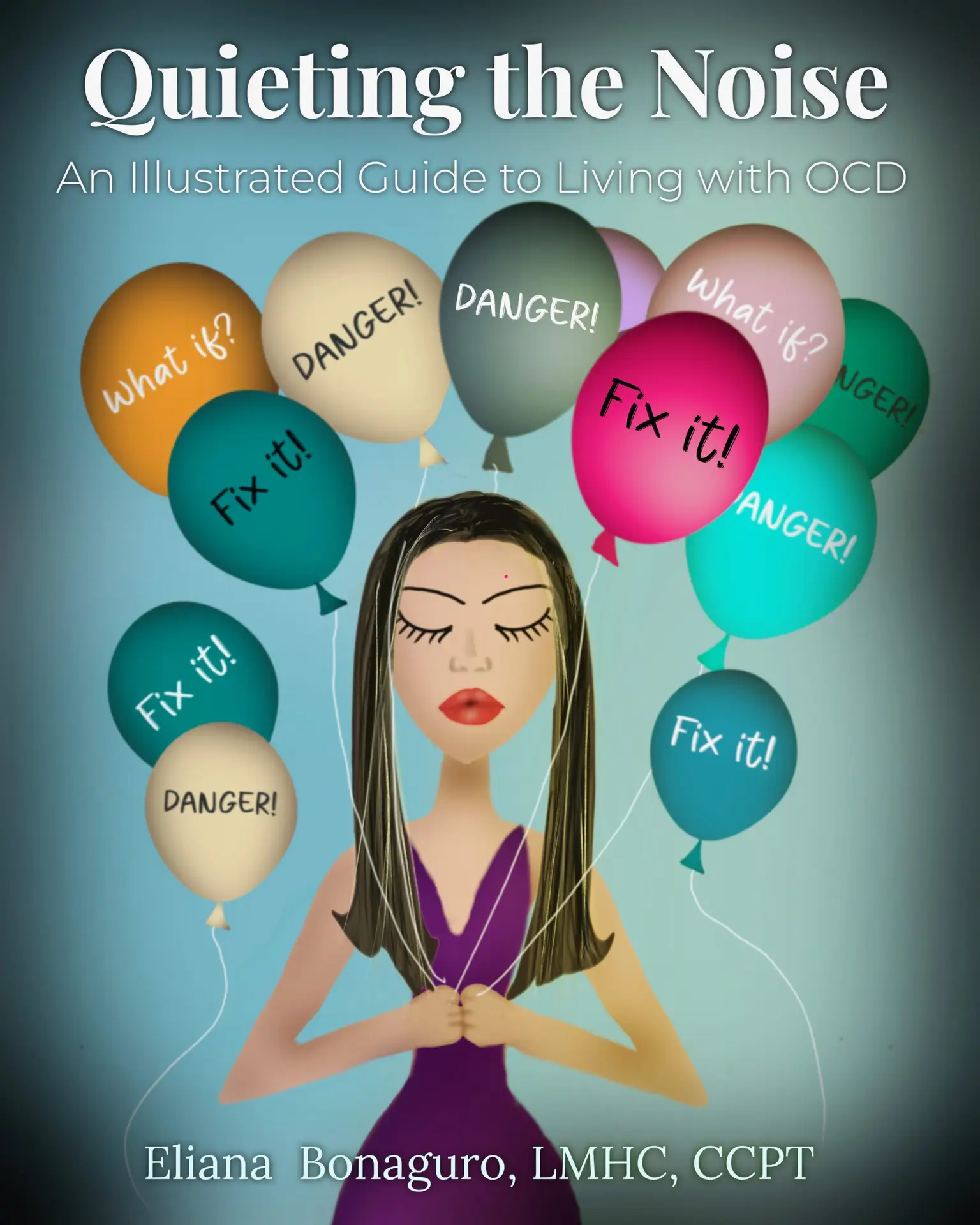
Author of Quieting the Noise: An Illustrated Guide to Living with OCD. Available on Amazon
Questions People Often Ask About Just Right OCD
Is Just Right OCD the same as perfectionism?
Not exactly. Perfectionism involves high standards or a desire for accuracy. Just Right OCD involves intrusive discomfort and compulsive behaviors meant to relieve that discomfort.
Why do I feel such intense discomfort when things are uneven?
Many people with Just Right OCD experience sensory discomfort when something appears asymmetrical or incomplete. The brain interprets this discomfort as something that must be corrected immediately.
Can Just Right OCD improve with therapy?
Yes. With evidence-based treatment such as ERP therapy, many people learn how to tolerate the uncomfortable sensation without performing rituals. Over time, the urges often decrease significantly.
Getting Help for Just Right OCD
If you are struggling with Just Right OCD, you are not alone. Many people experience this subtype of obsessive-compulsive disorder, and effective treatment is available.
Working with a therapist trained in ERP therapy for OCD can help you understand the patterns driving the cycle and gradually reduce compulsive behaviors.
With the right support, it is possible to regain flexibility, reduce anxiety, and spend less time trapped in the exhausting loop of trying to make everything feel “just right.”