If you struggle with magical thinking OCD, you may feel as if your thoughts, words, or small actions have the power to cause real events in the world. A passing thought might suddenly feel dangerous. A phrase you said earlier may feel like it could somehow trigger harm.
People experiencing magical thinking OCD often know logically that these fears do not make sense, yet the anxiety feels very real. The mind begins to treat coincidence as evidence and responsibility as infinite.
You may find yourself replaying thoughts, avoiding certain words, performing mental rituals, or trying to “neutralize” bad thoughts with good ones. Over time, the cycle becomes exhausting.
The good news is that magical thinking OCD is highly treatable, and many people recover by learning how OCD operates and using evidence-based treatments like Exposure and Response Prevention (ERP).
What Is Magical Thinking OCD?
Magical thinking OCD is a subtype of obsessive-compulsive disorder in which a person believes their thoughts, actions, or mental rituals can influence events in ways that defy normal cause and effect.
For example, someone may worry:
- “If I think about someone dying, it might happen.”
- “If I don’t repeat a phrase in my head, something bad could happen to my family.”
- “If I step on the wrong tile, it could cause harm later.”
This experience is often connected to thought-action fusion, a cognitive distortion common in OCD where people feel their thoughts are morally equivalent to actions or capable of causing events.
Although magical thinking exists in many cultures and superstitions, magical thinking OCD goes much further. The thoughts become intrusive, distressing, and repetitive, and the person feels compelled to neutralize them.
Magical Thinking OCD Can Feel Frightening and Is More Common Than People Realize
Many people experiencing magical thinking OCD feel embarrassed or afraid to talk about it. The thoughts can feel irrational, and people often worry others will misunderstand.
But intrusive thoughts are actually extremely common. Research shows that nearly everyone experiences strange or disturbing thoughts from time to time.
The difference with OCD is not the thought itself. It is how the brain interprets the thought.
When OCD is involved, the mind treats the thought as:
- Important
- Dangerous
- A sign of responsibility
This interpretation triggers anxiety, which leads to compulsions meant to prevent harm. These compulsions may include:
- Repeating phrases or prayers mentally
- Avoiding certain numbers, objects, or words
- Reassuring yourself repeatedly
- “Undoing” thoughts with other thoughts
- Performing rituals to neutralize imagined danger
Over time, the brain learns that rituals temporarily reduce anxiety, which strengthens the OCD cycle.
How Magical Thinking OCD Develops
Several cognitive patterns tend to fuel magical thinking OCD:
Thought-Action Fusion
The belief that thinking something makes it more likely to happen.
Inflated Responsibility
Feeling responsible for preventing harm—even when the connection between thoughts and events is unrealistic.
Intolerance of Uncertainty
The mind demands absolute certainty that harm will not occur.
Overestimation of Threat
Small coincidences begin to feel like proof that thoughts have power.
These patterns reinforce each other and make the OCD cycle stronger.
Magical Thinking OCD Treatment: How Therapy Helps Break the Cycle
Effective magical thinking OCD treatment focuses on changing the way the brain responds to intrusive thoughts.
One of the most effective treatments is Exposure and Response Prevention (ERP), a specialized form of cognitive behavioral therapy.
ERP works by gradually helping people face the thoughts or situations that trigger anxiety without performing compulsions.
For example, exposures might include:
- Allowing intrusive thoughts to exist without neutralizing them
- Writing feared phrases without undoing them
- Thinking the thought intentionally without performing rituals
- Sitting with uncertainty instead of seeking reassurance
Over time, the brain learns something important:
Thoughts are not dangerous, and anxiety fades on its own.
As the fear response decreases, compulsions lose their power.
What Magical Thinking OCD Therapy Looks Like
In therapy for magical thinking OCD, sessions typically include:
- Understanding the OCD cycle
- Identifying intrusive thoughts and compulsions
- Building an exposure hierarchy
- Practicing ERP exercises gradually
- Learning cognitive tools to challenge distorted beliefs
- Developing tolerance for uncertainty
The goal is not to eliminate intrusive thoughts. Everyone has them.
Instead, therapy helps you change your relationship with thoughts so they no longer control your behavior.
Many clients find that once they stop responding to OCD with rituals, the thoughts gradually lose their intensity.
Magical Thinking OCD Treatment: How Therapy Helps Break the Cycle
Effective magical thinking OCD treatment focuses on changing the way the brain responds to intrusive thoughts.
One of the most effective treatments is Exposure and Response Prevention (ERP), a specialized form of cognitive behavioral therapy.
ERP works by gradually helping people face the thoughts or situations that trigger anxiety without performing compulsions.
For example, exposures might include:
- Allowing intrusive thoughts to exist without neutralizing them
- Writing feared phrases without undoing them
- Thinking the thought intentionally without performing rituals
- Sitting with uncertainty instead of seeking reassurance
Over time, the brain learns something important:
Thoughts are not dangerous, and anxiety fades on its own.
As the fear response decreases, compulsions lose their power.
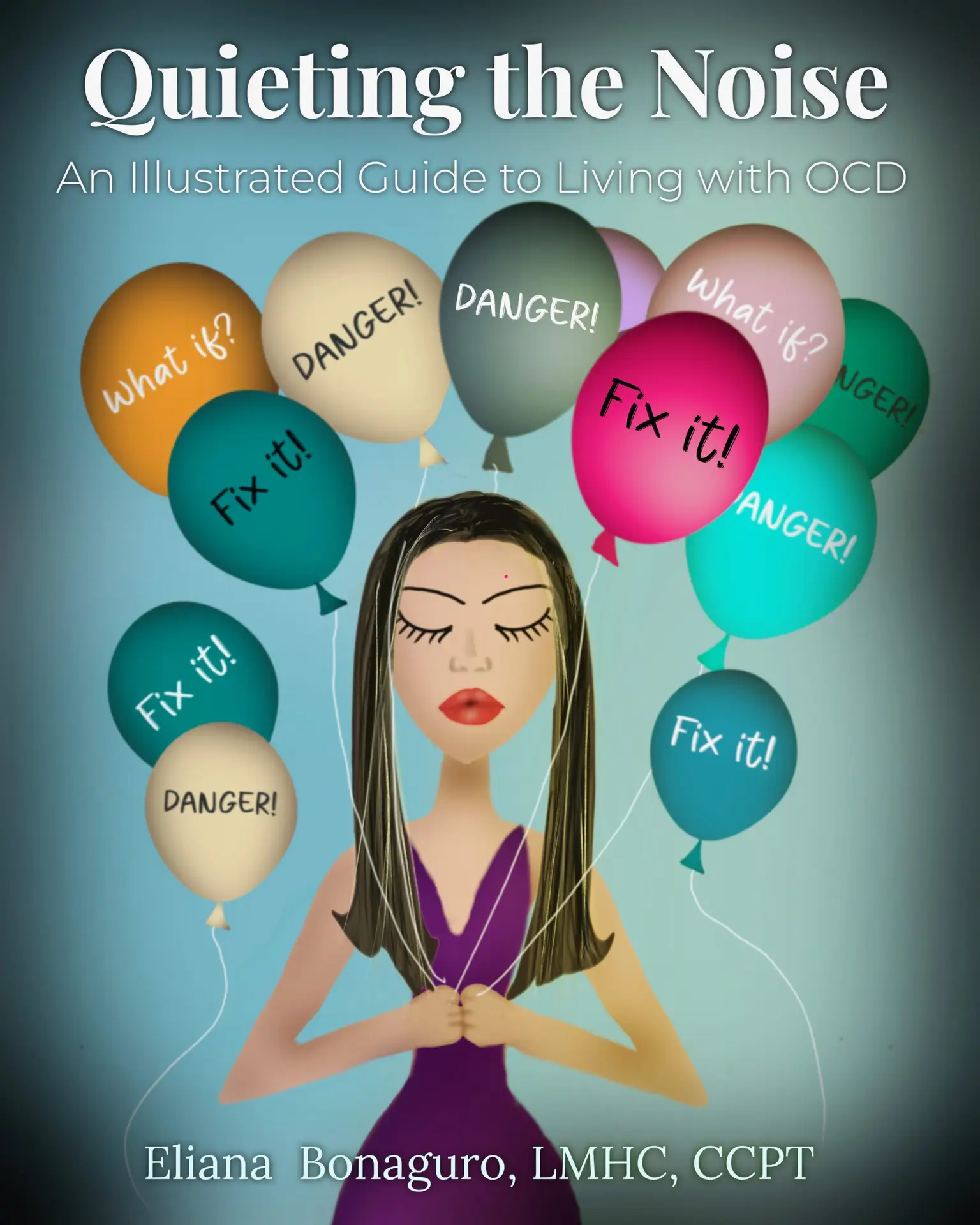
I specialize in the treatment of OCD and anxiety disorders and have completed advanced training in Cognitive Behavioral Therapy for OCD and anxiety through the Beck Institute of Cognitive Behavioral Therapy . I am also a member of the International OCD Foundation (IOCDF) and the author of Quieting the Noise: An Illustrated Guide to Living with OCD, a visual guide that helps people understand obsessive-compulsive disorder and learn practical tools for managing intrusive thoughts.
Through evidence-based treatment approaches such as ERP, cognitive restructuring, and mindfulness strategies, many people are able to break free from the cycle of magical thinking OCD and regain a sense of freedom from intrusive thoughts.
Author of Quieting the Noise: an Illustrated Guide to Living with OCD. Available on Amazon
But You May Still Have Questions About Magical Thinking OCD
What if my thoughts really do cause something bad to happen?
This fear is very common in magical thinking OCD. OCD tries to convince you that your thoughts have unusual power. In therapy, we explore these beliefs carefully and gradually test them through exposure exercises. Over time, people learn that thoughts are not capable of causing real-world harm.
What if I can’t tolerate the anxiety during exposures?
Exposure therapy is done gradually. We start with smaller steps and build tolerance over time. Many people are surprised by how quickly anxiety decreases once the brain stops performing compulsions.
What if I’ve had these thoughts for years?
Even long-standing OCD can improve significantly with treatment. The brain remains capable of learning new patterns throughout life.
You Don’t Have to Stay Stuck in Magical Thinking OCD
If you are struggling with magical thinking OCD, you are not alone—and you are not “crazy” for having these thoughts. OCD is a well-understood condition, and effective treatment exists.
With the right support and structured treatment such as ERP therapy, many people learn to step out of the cycle of fear and regain control of their lives.
If you would like help with magical thinking OCD treatment, you can reach out to schedule a consultation and learn more about how therapy can help you move forwar
Get Help for Magical Thinking OCD
If you are struggling with magical thinking OCD, working with a therapist who specializes in obsessive-compulsive disorder can make a significant difference. I provide evidence-based OCD treatment using Exposure and Response Prevention (ERP) for individuals experiencing intrusive thoughts, mental rituals, and responsibility fears.
You can learn more about my approach to OCD therapy in NYC or OCD Services in Florida and New York State , or read about how therapy can help with different types of OCD including contamination OCD, harm OCD, relationship OCD, and magical thinking