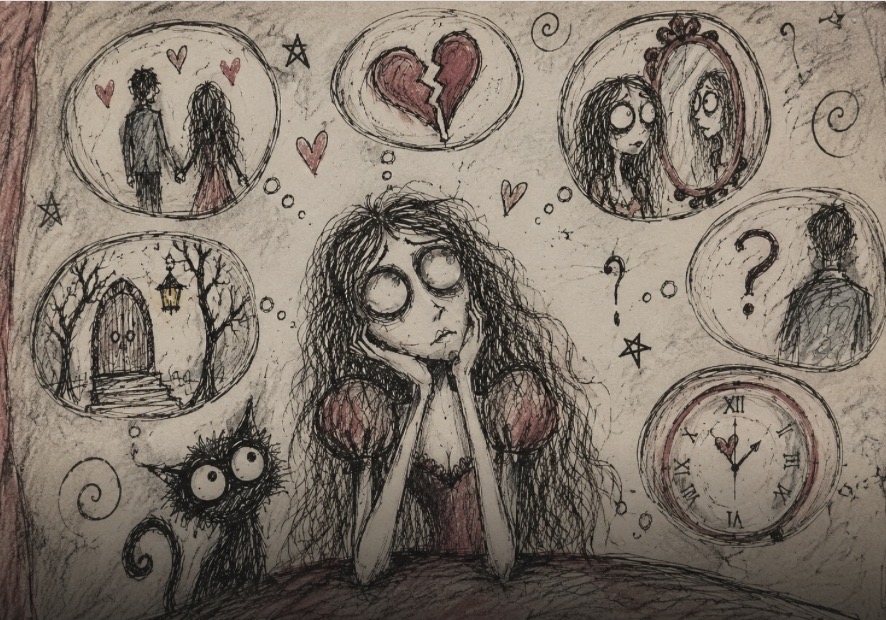
Relationship OCD doesn’t always look like someone constantly wondering whether they love their partner.
One person may become consumed by whether they chose the right relationship. Another may fixate on attraction or a partner’s perceived flaws. Someone else may know they want the relationship but experience intense ROCD fear of abandonment or ROCD jealousy, watching for signs that their partner could lose interest or become attracted to someone else.
These experiences may seem unrelated, but the different types of relationship OCD often share the same underlying pattern. Uncertainty creates anxiety, and anxiety creates an urge to find an answer. Checking, comparing, analyzing, and reassurance seeking may bring temporary relief, but the doubt eventually returns.
Recognizing these different ROCD symptoms can be especially important because relationship OCD is not always recognizable as OCD.
What Are the Different Types of Relationship OCD?
The types of relationship OCD are better understood as themes or presentations rather than official diagnostic subtypes. OCD can attach itself to different aspects of a relationship, and the focus can change over time.
Some people question whether they love their partner enough. Others experience partner-focused ROCD, becoming preoccupied with appearance, intelligence, personality, or other characteristics. Attraction, commitment, jealousy, infidelity, rejection, and abandonment can also become obsessive themes.
Although the content changes, similar ROCD compulsions often appear across these presentations. The person tries to resolve uncertainty by checking feelings, reviewing memories, comparing, researching, monitoring a partner, or seeking reassurance.
Can ROCD Make You Question Whether You Love Your Partner?
One common presentation centers on your own feelings toward your partner.
A perfectly ordinary period of feeling less romantic, excited, or connected can suddenly seem significant. Instead of allowing feelings to fluctuate naturally, you may start monitoring whether you love your partner “enough” or whether you feel the way someone in the “right” relationship should feel.
These ROCD symptoms can turn the relationship into an ongoing evaluation.
You may mentally review happier moments, compare the relationship with previous ones, imagine being single, or examine how much you miss your partner when you are apart.
The problem is that checking rarely produces lasting certainty. One question is answered, but another soon replaces it.
What Is Partner-Focused ROCD?
With partner-focused ROCD, the obsessive attention shifts toward characteristics of your partner.
A feature you once barely noticed can suddenly feel impossible to ignore. Appearance is a common focus, but the obsession might instead involve intelligence, career, ambition, personality, humor, social skills, voice, mannerisms, or habits.
The person may intellectually understand that nobody is perfect while simultaneously feeling compelled to determine whether a particular characteristic means they have chosen the wrong partner.
Partner-focused ROCD can also lead to constant comparison. You might compare your partner with strangers, friends’ partners, former partners, people online, or an imagined ideal partner.
The comparison itself can become one of the ROCD compulsions keeping the uncertainty alive.
Why Do I Keep Checking Whether I’m Attracted to My Partner?
Attraction is another common relationship OCD theme.
You might notice that you don’t feel particularly attracted to your partner at a certain moment. Instead of letting that experience pass, attention turns inward and attraction becomes something to measure.
You may examine your emotional response when looking at your partner, compare them with other people, recall times when attraction felt stronger, or deliberately imagine someone else to test your reaction.
These ROCD symptoms can create an unfortunate paradox: the more closely you monitor spontaneous feelings, the less spontaneous they become.
This pattern frequently overlaps with partner-focused ROCD. An ordinary physical characteristic can become evidence to inspect rather than simply one feature of a whole person.
Attraction naturally fluctuates in long-term relationships. OCD can transform that normal fluctuation into a problem demanding an immediate answer.
Can Relationship OCD Cause Jealousy?
Yes, ROCD jealousy can become another expression of obsessive uncertainty.
The focus is often not ordinary jealousy itself but the repeated need to establish whether a threat exists. An ambiguous interaction, a new coworker, a social-media connection, or a change in your partner’s behavior may suddenly seem loaded with significance.
With ROCD jealousy, you may monitor how your partner interacts with other people, compare yourself with perceived rivals, revisit conversations, or look for clues that attraction to somebody else is developing.
It is important to distinguish this from the idea that all jealousy is OCD. Jealousy is a human emotion, and concerns about infidelity can sometimes be grounded in actual relationship circumstances.
What makes ROCD jealousy clinically relevant is the obsessive-compulsive process surrounding uncertainty: intrusive doubt followed by repeated attempts to obtain certainty.
Those attempts can become ROCD compulsions, even when they initially feel like reasonable investigation.
Can Relationship OCD Cause Fear of Abandonment?
For some people, relationship OCD points in almost the opposite direction from the classic “Do I love my partner?” presentation.
ROCD fear of abandonment centers on whether your partner still wants you.
A delayed text, a quieter evening, less affection, or an unfamiliar facial expression may trigger intense concern about rejection. The person may begin reading into tone, reviewing conversations, monitoring behavior, or seeking reassurance that the relationship is okay.
With ROCD fear of abandonment, ordinary ambiguity can begin to feel threatening because there is no way to completely guarantee what another person will feel or do in the future.
Again, fear of being left does not automatically indicate OCD. Attachment patterns, previous experiences, genuine relationship instability, and other factors can contribute to abandonment fears.
But when ROCD fear of abandonment is present, attempts to eliminate uncertainty can become repetitive and difficult to resist.
When ROCD Jealousy and Fear of Abandonment Overlap
ROCD jealousy and ROCD fear of abandonment can easily reinforce each other.
If the core fear is losing your partner, another person may begin to represent a possible threat. That can increase monitoring and comparison. The more you monitor, the more ambiguous information you find—and the more anxious you become.
Someone experiencing ROCD jealousy might repeatedly check social media or replay an interaction between their partner and someone else. Someone experiencing ROCD fear of abandonment may scan their partner’s face, voice, messages, or affection for evidence that something has changed.
Both patterns can create powerful urges for reassurance.
Unfortunately, reassurance usually answers only the current version of the fear. OCD can always generate another possibility.
What ROCD Compulsions Do These Different Themes Have in Common?
Despite their different content, many types of relationship OCD lead to remarkably similar behaviors.
Common ROCD compulsions include checking your feelings, comparing your partner with other people, mentally reviewing good and bad moments, repeatedly asking friends or family what they think, researching relationships online, rereading texts, monitoring facial expressions, checking social media, or imagining a breakup to test your emotional response.
Many compulsions happen entirely inside the mind.
This can make them difficult to identify. An hour spent analyzing whether you really love your partner may feel like responsible problem-solving rather than a ritual.
But the function matters.
If the analysis is repeatedly being used to make uncertainty disappear, it may be reinforcing the very cycle you are trying to escape.
Why Doesn’t Reassurance Resolve Relationship OCD?
Reassurance often does make someone feel better—temporarily.
That’s precisely why it becomes so compelling.
You find evidence that your partner loves you. Your attraction suddenly feels strong again. Your partner reassures you that nothing is wrong. Anxiety drops.
But your brain can learn that relationship uncertainty is dangerous and must be resolved before you can feel safe.
This is particularly relevant to partner-focused ROCD, jealousy, attraction checking, and abandonment fears. The specific reassurance may change, while the underlying ritual remains remarkably similar.
Eventually another uncertainty appears, and the cycle starts again.
Why Can ROCD Get Worse With Commitment?
Engagement, marriage, moving in together, or having children can intensify ROCD symptoms because the perceived consequences of making the “wrong” choice become greater.
For someone already struggling with uncertainty, commitment can create pressure to know with absolute confidence that the relationship is right.
Breaking up can sometimes become an escape from that uncertainty. Once the relationship ends, the immediate question disappears and anxiety may fall dramatically.
That does not mean someone with OCD should remain in an unhealthy or unwanted relationship. It means it can be useful to distinguish a considered decision from an urgent attempt to obtain relief from uncertainty.
How Do You Know If It’s ROCD or a Real Relationship Problem?
This is one of the hardest questions surrounding relationship OCD because real relationships do have problems.
Having OCD does not mean every concern is irrational. People can be incompatible. Relationships can become unhealthy. Feelings can change.
Instead of endlessly trying to prove whether a particular thought is “real” or “OCD,” consider the process that follows it.
If the same concern is analyzed repeatedly, reassurance lasts only briefly, checking becomes difficult to resist, or resolving one uncertainty quickly produces another, the obsessive-compulsive cycle may be more informative than the specific content of the thought.
This is true whether the concern involves partner-focused ROCD, attraction, commitment, ROCD jealousy, or abandonment.
Can Relationship OCD Change Themes Over Time?
Yes. The focus can move.
Someone may initially worry about attraction, later become preoccupied with a partner’s flaws, and eventually develop ROCD fear of abandonment.
This is another reason understanding the types of relationship OCD can be useful. If treatment focuses only on answering the current question, OCD can simply find another question.
Effective treatment instead targets the process underneath the changing themes.
How Are Different Types of Relationship OCD Treated?
Treatment is not designed to prove that your relationship is right or convince you to stay with your partner.
Exposure and Response Prevention (ERP) is an evidence-based treatment for OCD. ERP helps you practice experiencing uncertainty without automatically performing the behaviors that have been providing temporary relief.
For someone experiencing partner-focused ROCD, that may mean resisting comparison or attraction checking. For jealousy, it might involve allowing uncertainty without investigating ambiguous interactions. With abandonment fears, it can involve experiencing an uncertain moment without repeatedly asking whether everything is okay.
Reducing these ROCD compulsions creates an opportunity to learn something different: uncertainty can exist without requiring immediate resolution.
I also integrate Cognitive Behavioral Therapy (CBT) and Acceptance and Commitment Therapy (ACT) in my work with OCD. Values can be particularly helpful because they shift attention away from endlessly evaluating the relationship and toward choosing how you want to participate in it.
Can You Have a Healthy Relationship With ROCD?
Recovery does not require eliminating every relationship doubt.
Relationships inherently involve uncertainty. Attraction fluctuates. People sometimes feel disconnected. Partners have flaws. Commitment involves risk.
The goal is not perfect certainty. It is becoming less controlled by the demand for it.
When ROCD symptoms become less dominant, there can be more room to experience the actual relationship instead of continually standing outside it and evaluating it.
You can listen to your partner, share experiences, maintain your own interests, express affection when you choose to, and make decisions based more on your values than on the need to immediately reduce anxiety.
Learn More About Relationship OCD
If your obsessive doubts center specifically on your partner’s previous romantic or sexual history, read my article on Retroactive Jealousy OCD.
If much of your OCD occurs through internal reviewing and analyzing, my article on mental compulsions in OCD explains how invisible rituals can keep uncertainty alive.
You can also learn more about Exposure and Response Prevention (ERP) and how response prevention changes the cycle between intrusive thoughts and compulsions.
If relationship doubts, checking, reassurance seeking, or ROCD symptoms are interfering with your life or relationship, learn more about working with a Relationship OCD therapist in NYC. I provide individualized OCD treatment for adults in New York, including ERP alongside CBT and ACT strategies.
About the Author
Eliana Bonaguro, LMHC, is a licensed mental health counselor specializing in OCD, anxiety disorders, panic disorder, and agoraphobia. She works with adults in New York and Florida and integrates evidence-based approaches including Cognitive Behavioral Therapy (CBT), Exposure and Response Prevention (ERP), and Acceptance and Commitment Therapy (ACT). Eliana has advanced training through the Beck Institute Of Cognitive Behavioral Therapy. She is also a member of the International OCD Foundation (IOCDF) . She is also the author of several books on OCD, anxiety, and panic. Learn more about Eliana and her approach at ellie-counseling.com.