OCD therapist for Obsessive-Compulsive Disorder (OCD) in New York and Florida

When OCD Starts to Take Over
If you are searching for anxiety and OCD therapy in New York or Florida, or an OCD therapist in New York, chances are that you or a loved one are struggling with intrusive thoughts, obsessions, or compulsions. Living with obsessive-compulsive disorder (OCD) can feel like being trapped in a mental tug-of-war. Your mind generates intrusive thoughts, images, or urges that feel alarming or completely out of line with who you are. Even when you recognize that these thoughts do not make sense, they can feel intensely real and hard to ignore.
You may find yourself caught in cycles of doubt and reassurance-seeking such as checking, reviewing, replaying, or mentally arguing with your own thoughts. Some people perform visible rituals, while others struggle primarily with internal compulsions like rumination, mental checking, or silent reassurance. No matter the form, OCD often creates a sense of urgency, as if you must do something to feel safe or certain.
Over time, OCD can begin to shrink your world. You may avoid situations that trigger anxiety, spend hours stuck in mental loops, or feel exhausted from constantly monitoring your thoughts and behavior.
How OCD Therapy Helps You Break the Cycle
OCD therapy helps you step out of that struggle and respond differently to intrusive thoughts. Rather than trying to eliminate anxiety or guarantee certainty, treatment focuses on changing the cycle that keeps OCD going.
With effective obsessive-compulsive disorder therapy, you learn how to tolerate uncertainty without engaging in compulsions. Over time, anxiety becomes more manageable, urges feel less urgent, and you regain confidence in your ability to live according to your values rather than OCD’s demands.
If this resonates, you are not alone, and you are not your thoughts. OCD therapy is designed to help break these cycles and restore a sense of freedom and trust in yourself.
Understanding OCD Symptoms
OCD symptoms can include intrusive thoughts, repetitive behaviors, mental rituals, intense doubt, and a strong need for certainty. Some people experience visible compulsions like checking or washing, while others struggle primarily with internal symptoms such as rumination, reassurance-seeking, or reviewing past events. While OCD symptoms can vary in content, they share a common cycle of anxiety followed by attempts to reduce that anxiety
OCD Is Not a Character Flaw — It’s a Treatable Anxiety Disorder
OCD thrives on uncertainty and doubt. The disorder targets your values, your sense of responsibility, and your desire to prevent harm, convincing you that certainty is both possible and necessary. Unfortunately, the more you try to neutralize anxiety through compulsions or reassurance, the stronger OCD becomes.
Many people with OCD are highly conscientious, thoughtful, and morally aware. These strengths can become vulnerabilities when OCD hijacks them, leading you to feel overly responsible for preventing bad outcomes or ensuring things are “just right.” Because compulsions sometimes reduce anxiety temporarily, it can feel as though they are necessary—even when they make life more restrictive in the long run.
Obsessive-compulsive disorder is far more common than most people realize, and it presents in many forms, including contamination fears, harm-related obsessions, intrusive taboo thoughts, relationship doubts, and mental compulsions. What these experiences share is not the content of the thoughts, but the pattern: intrusive doubt followed by attempts to regain certainty.
The good news is that OCD is highly treatable. With the right therapeutic approach, it’s possible to learn how to respond differently to intrusive thoughts and gradually loosen OCD’s grip.
How OCD Therapy Helps Break the Cycle
Obsessive-compulsive disorder therapy, also known as evidence-based OCD treatment, focuses on changing how you respond to intrusive thoughts and anxiety rather than trying to eliminate them.The goal is not to convince you that your fears are impossible, but to help you tolerate uncertainty without engaging in compulsions.
A CBT-based approach to OCD treatment often includes exposure and response prevention (ERP), which helps you gradually face feared thoughts or situations while resisting the urge to neutralize anxiety. Over time, your nervous system learns that anxiety can rise and fall on its own—and that you don’t need to perform rituals or mental reviews to stay safe.
In therapy, we work collaboratively to identify your specific OCD patterns, including subtle mental compulsions that are easy to miss. Sessions are structured and intentional, but also paced carefully and compassionately. You’ll learn how OCD operates, how it pulls you into endless “what if” questions, and how to step out of that cycle.
As treatment progresses, many clients notice that intrusive thoughts lose their power. Anxiety becomes more tolerable, urges feel less urgent, and you gain confidence in your ability to live according to your values rather than OCD’s rules. Therapy helps you build flexibility, self-trust, and resilience—without needing certainty first.
I provide telehealth obsessive-compulsive disorder therapy for adults across New York and Florida, including clients in New York City, Brooklyn, Manhattan, Queens, Westchester, Miami, Orlando, Tampa, Fort Myers, and Naples.
Common Questions About OCD Therapy
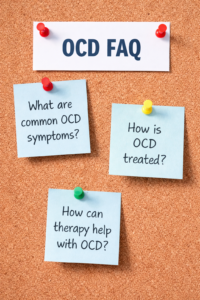
What if my thoughts feel too disturbing to talk about?
OCD often targets thoughts that feel frightening or taboo, which can make them especially hard to share. In therapy, intrusive thoughts are treated as symptoms—not reflections of your character or intent. You don’t need to censor yourself to receive help.
Will ERP OCD therapy make my anxiety worse?
Exposure response prevention (ERP) is carefully planned and collaborative. While anxiety may increase temporarily during exposures, the goal is to help you learn that anxiety is tolerable and temporary. Over time, most people experience a significant reduction in distress and compulsive urges.
What if I have “Pure O” or mostly mental compulsions?
OCD does not require visible rituals. Mental compulsions such as rumination, checking your feelings, or seeking internal certainty are just as treatable. Therapy focuses on both external and internal patterns.
What is OCD treatment like?
OCD treatment typically involves cognitive behavioral therapy (CBT) with exposure and response prevention (ERP). Rather than eliminating intrusive thoughts, treatment focuses on helping you tolerate uncertainty and reduce compulsions. Over time, anxiety decreases and OCD loses its intensity.
How can an obsessive compulsive therapist help me?
An OCD therapist New York helps you understand how OCD works and teaches you how to respond to intrusive thoughts differently. Rather than trying to eliminate thoughts or guarantee certainty, treatment focuses on changing the cycle that keeps OCD going.
OCD tends to follow a predictable pattern: intrusive thought → anxiety → compulsion or reassurance → temporary relief → stronger doubt. An OCD therapist helps you break that loop.
What types of OCD do you treat?
I treat all major subtypes of obsessive-compulsive disorder using evidence-based approaches such as Exposure and Response Prevention (ERP) and cognitive behavioral therapy. OCD can attach itself to almost any theme. While the content of the thoughts may differ, the underlying cycle of intrusive doubt, anxiety, and compulsive behaviors remains the same.
I treat the following OCD subtypes. If one feels familiar, you can click to learn more:
Relationship OCD (ROCD) – Intrusive doubts about love, attraction, compatibility, or whether a relationship is “right.”
Contamination OCD – Fear of germs, illness, bodily fluids, chemicals, or environmental toxins.
Magical Thinking OCD – Belief that thoughts, numbers, rituals, or superstitions can prevent harm or cause events.
“Just Right” OCD – Intense discomfort when things do not feel symmetrical, balanced, or exact.
OCD About OCD – Obsessive fear of never recovering or constantly monitoring whether symptoms are gone.
Moral Scrupulosity – Fear of being immoral, unethical, or sinful; excessive guilt and moral self-doubt.
Health Anxiety–Focused OCD – Repetitive checking, body monitoring, and fear of serious illness.
Harm OCD – Intrusive fears of harming oneself or others despite having no desire to do so.
Pure O (Primarily Obsessional OCD) – Predominantly mental compulsions such as rumination, analysis, and reassurance seeking.
Checking OCD – Repeated checking of doors, appliances, messages, or responsibilities to prevent imagined harm.
Existential OCD – Distressing preoccupation with philosophical questions about reality, identity, or meaning.
Perfectionism and Responsibility OCD – Fear of making mistakes or causing harm due to imperfect action.
Sexual Orientation OCD (SO-OCD) – Intrusive doubts about one’s sexual orientation that feel urgent and distressing.
Although the themes differ, OCD is not about the content of the thought — it is about how the mind responds to uncertainty. Treatment focuses on breaking the cycle of reassurance, mental review, and compulsive avoidance.
Can ADHD and OCD co-occur?
Yes. It’s common for conditions like ADHD and OCD to occur together, and symptoms can overlap or influence each other. When this happens, treatment can tailor both. Click here to learn more about OCD and ADHD co-occurrence
Why can’t I stop worrying my partner will leave me? Could this be ROCD?
It could be. In Relationship OCD (ROCD), intrusive doubts often focus on fears that a partner might cheat, lose interest, or abandon the relationship. To reduce anxiety, people may repeatedly check social media, seek reassurance, or analyze their partner’s behavior, which can unintentionally keep the OCD cycle going.
Learn more about fear-of-abandonment Relationship OCD.
About your OCD Therapist

Eliana Bonaguro, LMHC, author of Quieting the Noise: Illustrated Guide to Living with OCD, an illustrated guide offering practical tools for living with OCD.
Available on Amazon.
I provide individual therapy and specialize in treating anxiety, panic disorder, social anxiety, and OCD with advanced training in cognitive behavioral therapy (CBT) for OCD, including exposure and response prevention (ERP). As an OCD therapist trained through the Beck Institute for Cognitive Behavior Therapy, one of the leading institutions in evidence-based treatment, I focus specifically on helping adults break free from obsessive-compulsive disorder using structured, research-supported OCD treatment.
A specialized OCD treatment emphasizes clear psychoeducation, careful identification of compulsions—including subtle mental rituals—and a compassionate understanding of how distressing OCD symptoms can feel. Sessions are structured and intentional, but never rushed or overwhelming. We move at a pace that respects both the science of OCD treatment and your nervous system.
As a therapist with years of experience treating anxiety disorders, I believe therapy should be structured yet humane. My approach integrates evidence-based techniques with deep respect for your values, identity, and lived experience. I also draw from my work as the author of an illustrated mental health guide, reflecting my commitment to explaining intrusive thoughts and anxiety in ways that feel understandable, grounding, and validating.
Intrusive thoughts, compulsions, or relentless doubt can interfere with daily life. I provide online OCD therapy for adults throughout New York and Florida. If you are searching for an OCD therapist in New York, NYC, or Florida, telehealth OCD therapy makes specialized care accessible wherever you are in the state. Whether you live in Manhattan, Brooklyn, Queens, Westchester, Miami, Orlando, Tampa, Fort Myers, or Naples, you can access evidence-based OCD treatment from home.
All sessions are conducted via secure telehealth, allowing you to access online OCD therapy and specialized obsessive-compulsive disorder treatment in a private and convenient setting.

Begin OCD Therapy in NYC and Florida
If intrusive thoughts, compulsions, or relentless doubt are interfering with your life, help is available. I
If you are searching for effective OCD treatment in New York or Florida, telehealth makes it possible to access specialized care from anywhere in tI offer online OCD therapy for adults throughout New York and Florida. If you are looking for an OCD therapist in New York or an OCD therapist in Florida, telehealth makes specialized treatment accessible whether you live in NYC, Brooklyn, Manhattan, Westchester, Miami, Orlando, Tampa, or elsewhere in the state.
Schedule a free consultation to discuss how OCD therapy can help you regain controlWith effective treatment, it’s possible to move toward a life guided by your values—not by fear or certainty-seeking.