Relationship OCD Therapist NYC
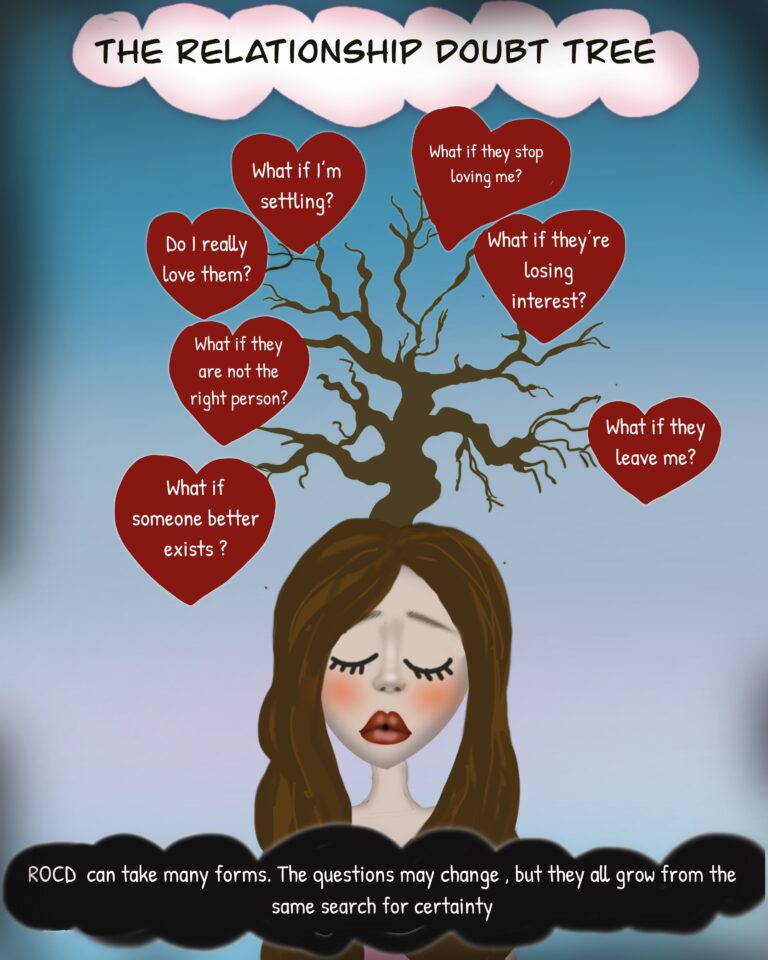
Are Intrusive Doubts About Your Relationship Taking Over Your Mind?
If you’re searching for a relationship OCD therapist NYC, you may feel caught in an exhausting loop of doubt that never fully resolves.
You might find yourself asking:
- Why do I constantly doubt my relationship even when nothing is wrong?
- Do I really love my partner?
- What if I’m settling or missing something better?
- What if they cheat, leave, or lose interest?
These thoughts don’t feel like passing worries. They feel urgent, important, and impossible to ignore.
Many people experiencing relationship OCD symptoms describe feeling mentally stuck, as if their mind keeps pulling them back into the same questions over and over again.
You might notice yourself:
- analyzing your feelings repeatedly
- checking whether your emotions feel “right”
- comparing your relationship to others
- replaying conversations in your mind
- seeking reassurance from friends, family, or the internet
Even when you get temporary relief, the doubt returns.
This is the nature of relationship doubts OCD. The problem is not the question itself, but the cycle of trying to answer it with certainty.
Why Relationship OCD Feels So Real and Overwhelming
Relationship OCD can feel deeply convincing because it targets something meaningful.
Unlike general anxiety, it doesn’t just create fear. It creates doubt about your decisions, your feelings, and your future.
Many clients describe:
- a constant need to “figure it out”
- difficulty trusting their own emotions
- fear of making a permanent mistake
Intrusive thoughts may sound like:
- “What if I don’t really love them?” (do I love my partner OCD)
- “What if this relationship isn’t right?”
- “What if I’m ignoring something important?”
Others experience:
- fear partner cheating OCD themes
- fears about attraction or compatibility
- concerns about emotional connection
- One of the most confusing aspects is trying to understand the difference between:
- normal relationship uncertainty
- and relationship anxiety vs OCD
The key distinction is that OCD creates:
- urgency
- repetition
- and a constant need for certainty
It doesn’t allow you to feel settled, even when nothing is actually wrong.
Relationship OCD Therapy NYC: How ERP Treatment Helps
Effective relationship OCD therapy NYC does not focus on proving whether your relationship is right or wrong.
Instead, it focuses on changing how you respond to uncertainty.
The most effective, evidence-based approach is Exposure and Response Prevention (ERP).
ERP is considered one of the most effective approaches for ROCD treatment and helps reduce intrusive thoughts and compulsive behaviors.
ERP helps you:
- face intrusive thoughts without trying to solve them
- reduce compulsions like reassurance seeking and mental checking
- build tolerance for uncertainty
- disengage from repetitive analysis
For example, instead of answering:
“What if I don’t love my partner enough?”
You learn to respond with:
“Maybe I do, maybe I don’t.”
At first, this can feel uncomfortable. But over time, your brain learns that it does not need to resolve the question to feel safe.
ERP is not about forcing yourself to feel certain or convincing yourself that everything is fine.
It is about changing your relationship with the thought itself.
Over time, as you reduce compulsions like ROCD reassurance seeking and mental checking, your brain learns that it does not need to resolve every doubt.
This is what allows anxiety to decrease naturally, rather than temporarily.
This is how the OCD cycle weakens.
If you’ve been searching for:
- relationship OCD treatment NYC
- a ROCD therapist NYC
- or an OCD therapist for relationship anxiety NYC
…it’s important to work with someone who understands OCD patterns specifically, not just relationship concerns.If you’re looking for relationship OCD therapy NYC, working with a ROCD therapist NYC can help you break patterns of doubt and reassurance seeking.I provide relationship OCD treatment NYC using ERP for individuals struggling with intrusive thoughts and relationship anxiety.
Common Relationship OCD Symptoms and Intrusive Thought Patterns
Relationship OCD often follows recognizable patterns, even though it can feel very personal.
Common relationship OCD symptoms include:
- persistent doubt about love or compatibility
- difficulty feeling certain about your emotions
- intrusive thoughts about the relationship ending
- urges to analyze or “check” your feelings
- fear of abandonment
A particularly common compulsion is:
👉 checking feelings OCD relationship patterns
This can look like:
- scanning your emotions to see if they feel “right”
- comparing your feelings to what you think they should be
- testing your reactions in different situations
- scanning for signs our
Another core pattern is:
👉 ROCD reassurance seeking
This may include:
- asking others for validation
- searching online for answers
- mentally reviewing past experiences
While these behaviors may reduce anxiety temporarily, they reinforce the cycle long-term.
Understanding these patterns is a key step in learning how to stop relationship OCD effectively.
Signs of Relationship OCD Symptoms in Daily Life
Relationship OCD doesn’t always look obvious. It often shows up in subtle, repetitive mental patterns that feel like “just thinking,” but are actually part of the OCD cycle.
You may notice:
-
difficulty staying present during time with your partner because your mind is analyzing
-
repeatedly checking if your feelings are “strong enough”
-
comparing your relationship to others or past experiences
-
feeling temporary relief after reassurance, followed by doubt returning
These patterns are often mistaken for normal overthinking, but when they become persistent and distressing, they are more consistent with relationship OCD symptoms.
Understanding these patterns helps clarify the difference between typical relationship concerns and OCD-driven doubt.
Work With a Relationship OCD Therapist in NYC Who Specializes in ERP
When it comes to OCD, specialization matters.
Many forms of therapy can unintentionally reinforce OCD by encouraging analysis, reassurance, or emotional checking.
Working with a relationship OCD therapist NYC who specializes in ERP ensures that treatment targets the actual mechanism of OCD.
I am an IOCDF member with advanced training in CBT and ERP from the Beck Institute of Cognitive Behavioral Therapy , and I specialize in treating OCD and anxiety disorders.
My approach focuses on:
- clear, structured treatment plans
- understanding your specific OCD patterns
- building practical skills to reduce compulsions
- helping you tolerate uncertainty without avoidance
In addition to therapy, I am the author of:
- Quieting the Noise: A Visual Guide to Living with OCD
- Yesterday It Rained: A Visual Guide to Living with Anxiety
My work combines evidence-based strategies with a clear and accessible style that helps clients understand what’s happening in their mind and how to respond differently.
I provide therapy throughout New York State, including:
- Manhattan
- Brooklyn
- Queens
- Westchester
…and frequently work with individuals in high-demand careers and fast-paced environments who are navigating anxiety, perfectionism, and relationship uncertainty. If you’ve been searching for ROCD treatment, working with a specialist can help you break the cycle of doubt and reassurance seeking.As an OCD therapist for relationship anxiety NYC, I focus on helping clients reduce compulsions and tolerate uncertainty.
Common Questions About Relationship OCD
Why do I constantly doubt my relationship even when nothing is wrong?
This is one of the most common experiences in ROCD.
The doubt is not a reflection of your relationship. It’s a reflection of how OCD interacts with uncertainty.
The more you try to figure it out, the more stuck you feel.
Is fear of a partner cheating OCD?
Yes. Fear partner cheating OCD is a common theme.
It may involve imagining scenarios, monitoring behavior, or seeking reassurance, even when there is no real evidence of a problem.
What are relationship OCD symptoms?
Common relationship OCD symptoms include:
- intrusive doubts
- compulsive checking
- reassurance seeking
- difficulty tolerating uncertainty
How to stop relationship OCD?
Learning how to stop relationship OCD involves:
- reducing compulsions
- practicing ERP
- allowing uncertainty instead of resolving it
Working with a specialist helps guide this process effectively.
Is it hard to find a relationship OCD therapist in NYC?
It can be.
Many therapists treat anxiety, but fewer specialize in OCD and ERP.
Working with a relationship anxiety OCD therapist NYC ensures that treatment is targeted and effective.
Why Specialized Treatment for Relationship OCD Matters
Not all therapy approaches are effective for OCD.
In fact, approaches that focus on analyzing thoughts, seeking clarity, or exploring feelings in depth can sometimes unintentionally strengthen the OCD cycle.
This is why working with a specialist in relationship OCD therapy NYC is important.
A targeted approach using ERP focuses on:
-
reducing compulsive behaviors
-
changing your response to intrusive thoughts
-
helping you build tolerance for uncertainty
With the right treatment, many people begin to notice:
-
less time spent analyzing
-
reduced urgency around intrusive thoughts
-
more ability to engage in their relationship without constant doubt
Online ROCD Therapy Across New York and Florida
While this page focuses on relationship OCD therapy in NYC, I also offer ROCD treatment via telehealth to clients in Florida, including Naples, Miami Beach, and Coral Gables.
Start Working With a Relationship OCD Therapist NYC
You don’t have to keep living in cycles of doubt, checking, and mental exhaustion.
With the right treatment, it is possible to:
- feel more grounded in your relationship
- reduce intrusive thoughts
- step out of constant analysis
- reconnect with your values instead of fear
If you’re looking for a relationship OCD therapist NYC of in Florida , I offer specialized, evidence-based treatment designed to help you move forward with more clarity and less anxiety.