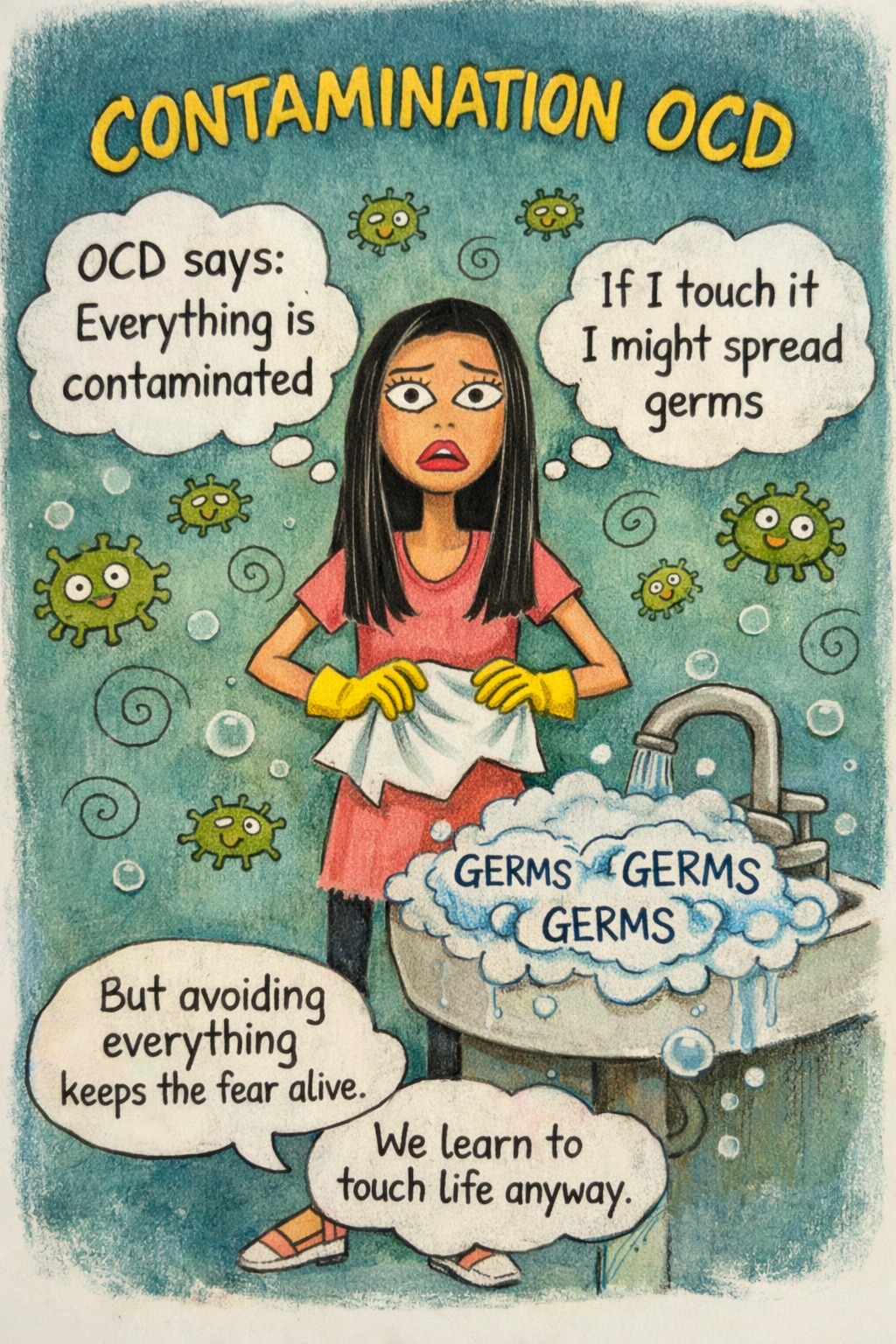
Do you constantly worry about germs, contamination, or getting sick and wonder whether you are a germophobic or have contamination OCD?
- Do you wash your hands repeatedly until they feel raw?
- Do you avoid touching objects that other people use?
- Do you feel anxious after touching public surfaces like door handles or shopping carts?
- Do intrusive thoughts about contamination keep returning even when you try to ignore them?
If this sounds familiar, you may be experiencing contamination OCD, one of the most common forms of obsessive-compulsive disorder.
Contamination OCD can make everyday activities feel overwhelming. Simple situations—touching a doorknob, sitting on public transportation, or shaking someone’s hand—may trigger intense anxiety and repetitive rituals meant to reduce fear.
But while contamination OCD can feel exhausting and isolating, effective treatment is available, and many people experience significant relief with the right therapy.We’re a studio in Berlin with an international practice in architecture, urban planning and interior design. We believe in sharing knowledge and promoting dialogue to increase the creative potential of collaboration.
Understanding Contamination OCD
Contamination OCD is a subtype of obsessive-compulsive disorder characterized by intrusive fears about germs, illness, toxins, or contamination.
These fears are not simply about being clean or hygienic. Instead, they involve persistent intrusive thoughts (obsessions) that trigger anxiety and lead to repetitive behaviors or mental rituals (compulsions).
Common contamination OCD fears include:
- Fear of bacteria, viruses, or illness
- Fear of toxic chemicals or environmental contamination
- Fear of spreading germs to loved ones
- Fear of bodily fluids or dirt
- Feeling “unclean” even when nothing visible is present
To cope with these fears, people often develop compulsive behaviors such as:
- Excessive handwashing or showering
- Repeated cleaning or disinfecting
- Avoiding public places or shared objects
- Throwing away items that feel contaminated
- Repeated reassurance seeking
While these behaviors may temporarily reduce anxiety, they reinforce the OCD cycle, causing fears to return even stronger.
Why Contamination OCD Feels So Powerful
Many people with contamination OCD know that their fears may be exaggerated, yet the anxiety still feels overwhelming.
This happens because OCD operates through a powerful anxiety reinforcement loop.
- An intrusive thought appears:
“What if this surface has dangerous germs?” - Anxiety spikes.
- A compulsion occurs (washing, cleaning, avoiding).
- Anxiety temporarily decreases.
- The brain learns:
“Washing prevents danger.”
This temporary relief teaches the brain to repeat the compulsion, strengthening the OCD cycle.
Over time, fears may expand. What begins as a concern about public bathrooms can spread to groceries, clothing, mail, or even physical contact with loved ones.
Eventually, daily life may become shaped by avoidance and ritualized behaviors.
How Therapy Helps Break the Contamination OCD Cycle
The most effective treatment for contamination OCD is Exposure and Response Prevention (ERP), a specialized form of cognitive behavioral therapy.
ERP helps people gradually face feared situations without performing compulsions.
Exposure exercises might include:
- Touching objects without immediately washing hands
- Delaying cleaning rituals
- Reducing reassurance seeking
- Practicing sitting with uncertainty about germs
Over time, the brain learns an important lesson:
Anxiety rises and falls naturally, even without compulsions.
As this learning occurs, the intensity of intrusive thoughts decreases and everyday situations become easier to handle.
If you’re looking for professional help, you can learn more about OCD https://www.ellie-counseling.com/ocd-therapy-nyc/therapy in New York City here:
What Contamination OCD Therapy Is Like
In therapy, we move at a pace that feels manageable while still helping you challenge OCD patterns.
Treatment usually involves:
Understanding OCD
First, we identify how intrusive thoughts and compulsions interact in your specific situation.
Building an Exposure Plan
We create a gradual hierarchy of exposures so that you can practice facing feared situations step by step.
Practicing Exposure and Response Prevention
You learn to approach anxiety-provoking situations while resisting compulsions.
Developing New Responses to Intrusive Thoughts
Instead of trying to eliminate thoughts entirely, therapy helps you change your relationship to them so they no longer control your behavior.
Over time, this process retrains the brain so intrusive fears lose their intensity.
Common Concerns About Contamination OCD Therapy
Exposure therapy can temporarily increase anxiety, but this discomfort is part of how the brain learns that feared outcomes are manageable. ERP is conducted gradually and collaboratively so you are never facing exposures alone.
What if my contamination fears are actually reasonable?
Therapy does not eliminate healthy caution. Instead, it helps restore balanced risk perception, reducing the exaggerated threat interpretations created by OCD.
What if I’ve struggled with this for years?
Even long-standing OCD can improve with evidence-based treatment. Many clients begin noticing changes once they consistently apply exposure strategies.
Frequently asked questions about contamination OCD
What is contamination OCD?
Contamination OCD is a subtype of obsessive-compulsive disorder involving intrusive fears about germs, illness, toxins, or contamination. These fears lead to compulsive behaviors such as excessive washing, cleaning, or avoidance.
How is contamination OCD treated?
The most effective treatment is Exposure and Response Prevention (ERP), a form of cognitive behavioral therapy that helps people gradually face feared situations while reducing compulsive behaviors.
Can contamination Obsessive Compulsive Disorder go away?
With appropriate treatment, many people experience significant improvement. Therapy helps retrain the brain’s response to intrusive thoughts so they become less distressing and less controlling. Exposure and response prevention (ERP) is the golden standard treatment contamination OCD
Is contamination OCD the same as being a germaphobe?
Not exactly. While both involve concerns about cleanliness, contamination OCD involves intrusive thoughts and compulsive behaviors that significantly interfere with daily life.
Find Help for Contamination Obsessive Compulsive Disorder (OCD)
Living with contamination OCD can feel isolating, but effective treatment is available.
If intrusive fears about germs, illness, or contamination are interfering with your life, therapy can help you break the cycle of anxiety and compulsions.
You can learn more about treatment here:
OCD Therapy in New York and Florida
Take the First Step Toward Relief
I offer evidence-based https://www.ellie-counseling.com/ocd-therapy-new-york-florida/OCD therapy using Exposure and Response Prevention (ERP) for adults struggling with intrusive thoughts, compulsions, and anxiety.
If you’d like to learn more about treatment or ask questions about whether therapy may be helpful for you, you’re welcome to schedule a free 15-minute consultation.
Together, we can explore ways to help you move beyond the cycle of fear and regain freedom in your daily life.
Eliana Bonaguro, LMHC, specializes in treating anxiety disorders and obsessive-compulsive disorder. She has advanced training in cognitive behavioral therapy for OCD through the Beck Institute and is a member of the International OCD Foundation.