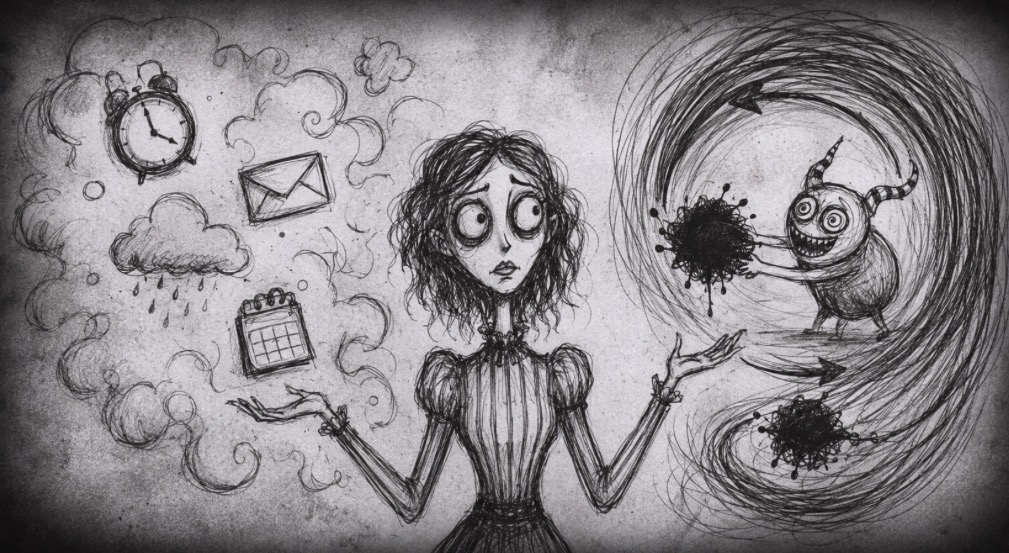
If you spend a lot of time worrying, overthinking, or imagining what could go wrong, you may wonder: Is this OCD or anxiety? Or what’s the difference between OCD vs anxiety?
It is not always easy to tell the difference between OCD vs anxiety.
Both obsessive-compulsive disorder (OCD) and anxiety can involve repetitive thoughts, uncertainty, physical tension, avoidance, and a seemingly endless stream of “what if?” questions. From the inside, they can feel remarkably similar.
But there is an important difference.
With OCD, the problem is not simply that you are anxious. With OCD your worries have recurrent themes and you become caught in a cycle in which an intrusive thought, image, urge, sensation, or doubt creates distress—and you feel driven to do something to resolve that distress or gain certainty.
That “something” is the compulsion.
And compulsions are not always visible. They can happen entirely inside your mind.
Understanding the pattern behind your anxiety can help clarify what may be keeping it going—and why the right treatment matters.
OCD vs Anxiety: What’s the Difference?
Anxiety is a normal human emotion. We all experience it when something feels threatening, uncertain, or important.
An anxiety disorder is different. Anxiety becomes persistent or excessive enough that it begins interfering with your life.
But what’s really the difference between OCD vs anxiety? For example, someone with generalized anxiety disorder (GAD) may worry excessively about several areas of everyday life, such as health, work, finances, relationships, responsibilities, or the future. The worry can feel difficult to control and may shift from one concern to another.
OCD can certainly cause anxiety too, but OCD has an additional component: obsessions and compulsions become connected in a repeating cycle.
An obsession might sound like:
What if I accidentally hurt someone?
What if I touched something contaminated?
What if I don’t really love my partner?
What does my past’s partner say about them? Or me?
What if I said something offensive?
What if I secretly wanted that thought?
What if I made a mistake and just can’t remember it?
The thought creates distress, doubt, guilt, disgust, or anxiety. You then feel an urge to somehow settle the question.
You might check. Review. Google. Ask someone. Avoid something. Wash. Compare. Analyze your feelings. Replay a memory. Try to prove the thought wrong.
You feel better—perhaps only for a moment.
Then the doubt returns.
That cycle is one of the biggest clues that what looks like ordinary anxiety may actually be OCD.
Read this article to learn about the different themes and OCD presentations
How to Tell the Difference Between OCD vs Anxiety
One common mistake is trying to distinguish OCD vs anxiety based only on the content of the worry.
In practice, the content can overlap.
Someone with anxiety might worry about their health. Someone with OCD might obsess about their health.
Someone with anxiety might worry about a relationship. Someone with relationship OCD might repeatedly question whether they love their partner enough.
Someone with anxiety might worry about making a mistake at work. Someone with OCD might repeatedly review an email, conversation, or decision because they cannot tolerate the possibility that they made a mistake.
So I often pay less attention to what a person is worried about and more attention to what happens next.
What do you do when the doubt appears?
That is often where the OCD cycle becomes easier to see.
OCD, Anxiety, and the Need for Certainty
OCD has a difficult relationship with uncertainty.
A question enters your mind, and instead of being able to leave it unanswered, you feel as though you must solve it.
Maybe you need to know that you definitely didn’t contaminate someone.
That you definitely love your partner.
That you definitely aren’t a bad person.
That the sensation in your body definitely isn’t dangerous.
That you definitely didn’t make a mistake.
That your memory is accurate.
The problem is that complete certainty is rarely available.
So you keep trying.
You examine the thought from another angle. You remember one more detail. You ask one more person. You search one more phrase online.
Each attempt promises closure.
Instead, the search for certainty teaches your brain that the question must be important enough to keep investigating.
Common OCD Compulsions and Mental Compulsions
When people hear the word OCD, they often picture obvious behaviors such as excessive handwashing or repeatedly checking a lock.
Those are real compulsions, but OCD can be much less visible.
Mental compulsions can include:
- Replaying conversations
- Reviewing memories
- Checking your emotions
- Trying to figure out what a thought “means”
- Mentally arguing with an intrusive thought
- Comparing your reactions with other people’s
- Repeating phrases or prayers internally
- Trying to replace a “bad” thought with a good one
- Testing yourself to see how you feel
- Trying to prove that something did or did not happen
Reassurance seeking can also become compulsive.
You may ask your partner, friend, therapist, doctor, or family member some version of the same question repeatedly. Or you may seek reassurance without involving another person at all—through Google searches, Reddit threads, old messages, photographs, medical information, or your own memories.
This is one reason OCD can go unrecognized. From the outside, you may simply look like someone who thinks a lot.
Inside, you may be spending hours trying to get certainty.
The OCD Cycle: Obsessions, Compulsions, and Temporary Relief
Both anxiety and OCD can lead people to seek relief.
But with OCD, relief itself often becomes part of a recognizable loop.
Imagine that you suddenly think:
What if I left the stove on?
You check it.
It is off.
For a moment, you feel relieved.
Then your mind says:
But did I really look at the right burner?
So you check again.
Or perhaps you leave the house and try to remember exactly what you saw.
Now you’re mentally reviewing.
Then you picture the stove.
Then you wonder whether the mental image is a real memory.
The original question has changed, but the process hasn’t.
Obsession → distress → compulsion → temporary relief → renewed doubt.
The compulsion works just well enough in the short term to make you want to use it again. But it does not teach your brain that you can tolerate uncertainty without solving the obsession.
That is how the OCD cycle can become stronger over time.
OCD vs Generalized Anxiety Disorder (GAD)
Generalized anxiety disorder often involves excessive worry across multiple areas of everyday life.
You may find yourself worrying about money in the morning, your performance at work in the afternoon, your health later that evening, and a family member before bed.
The worries can be persistent and difficult to control. They may also be accompanied by restlessness, irritability, difficulty concentrating, sleep problems, fatigue, or muscle tension.
There can certainly be repetitive thinking in GAD. In fact, worry itself can become extremely repetitive.
The distinction is not that people with GAD worry about “real things” while people with OCD worry about irrational things. Human minds are much messier than that.
Instead, OCD tends to involve a more pronounced obsession-compulsion process: intrusive doubt or distress followed by attempts to neutralize it, prevent a feared outcome, or obtain certainty.
And sometimes a person has both.
Can You Have OCD and Anxiety at the Same Time?
Yes.
Having OCD does not prevent you from also having generalized anxiety disorder, panic disorder, social anxiety, or another condition.
This can make self-diagnosis particularly difficult.
For example, someone may have broad worries about work, finances, and family while also experiencing a very specific OCD cycle around contamination.
Another person may have panic attacks but also compulsively monitor their body, repeatedly research symptoms, or seek reassurance about whether a sensation is dangerous.
This is why a good assessment looks at the function of the behavior, not simply the presence of anxiety.
The question becomes:
When anxiety or uncertainty appears, what are you doing in response to it—and what does that response teach your brain?
How Treatment for OCD and Anxiety Is Different
The difference between OCD and other forms of anxiety is more than a diagnostic technicality.
It can change how therapy approaches the problem.
Cognitive behavioral therapy (CBT) is commonly used for anxiety disorders. Treatment may include learning to recognize unhelpful patterns of thinking, changing behaviors that maintain anxiety, developing greater tolerance for uncertainty, and gradually approaching feared situations rather than avoiding them.
For OCD, Exposure and Response Prevention (ERP) is a specialized form of behavioral treatment.
ERP does something that can initially feel counterintuitive.
Instead of helping you obtain certainty about the obsession, ERP helps you gradually face triggers while reducing the compulsions you normally use to feel safe, certain, or relieved.
If your obsession says, “You need to figure this out,” treatment does not necessarily help you figure it out.
You learn that you don’t have to.
Over time, the goal is not to eliminate every intrusive thought or guarantee that nothing uncomfortable will happen. It is to change your relationship with uncertainty so that an intrusive thought no longer gets to dictate what you do next.
Is Overthinking a Compulsion in OCD?
Possibly.
One clue is whether your thinking feels less like ordinary reflection and more like a task you have to complete before you can move on.
Ask yourself:
Am I thinking about this because the thinking is useful—or because I am trying to make an uncomfortable feeling or uncertainty disappear?
You might notice that you keep arriving at an answer but cannot hold onto it.
You already decided that the conversation went fine—but you replay it again.
You already concluded that you love your partner—but you check your feelings again.
You already know you washed your hands—but you try to reconstruct exactly what you touched afterward.
You already received reassurance—but now you have a slightly different version of the question.
When the goal becomes achieving a feeling of complete certainty, the analysis itself may be functioning as a compulsion.
How Do I Know If I Have OCD or Anxiety?
There isn’t one question that can diagnose OCD.
But if you are trying to understand your own pattern, look beyond how anxious you feel.
Look at the cycle.
Do intrusive doubts, thoughts, images, sensations, or urges repeatedly grab your attention?
Do you feel compelled to resolve them?
Do you check, avoid, research, confess, seek reassurance, review memories, analyze your thoughts, or test your feelings?
Does doing those things give you temporary relief—only for another doubt to appear?
If so, an OCD assessment may be worthwhile.
If your worries are broad, persistent, difficult to control, and spread across many areas of everyday life without a clear obsession-compulsion cycle, another anxiety disorder may better explain what you are experiencing.
Sometimes the answer is both.
OCD and Anxiety Therapy in New York and Florida
Ironically, trying to become 100 percent certain whether you have OCD can itself turn into another cycle of researching, comparing symptoms, and checking.
You don’t need to diagnose yourself before asking for help.
I specialize in working with adults experiencing OCD, intrusive thoughts, anxiety, and panic using evidence-based approaches including CBT and Exposure and Response Prevention (ERP).
If you’re unsure whether what you’re experiencing is OCD, another anxiety disorder, or a combination of both, an assessment can help clarify the pattern and determine what kind of treatment makes sense.
I provide online therapy for adults in New York and Florida. If you’re considering specialized therapy, you can schedule a consultation to see whether we may be a good fit.
About the Author
Eliana Bonaguro is a Licensed Mental Health Counselor (LMHC) in New York and Florida and the author of mental health guides focused on anxiety and obsessive-compulsive disorder (OCD). She has completed advanced training through the Beck Institute and is a member of the International OCD Foundation (IOCDF). Her work combines evidence-based clinical knowledge with clear, accessible guidance to help readers better understand anxiety, OCD, and the path toward meaningful change.