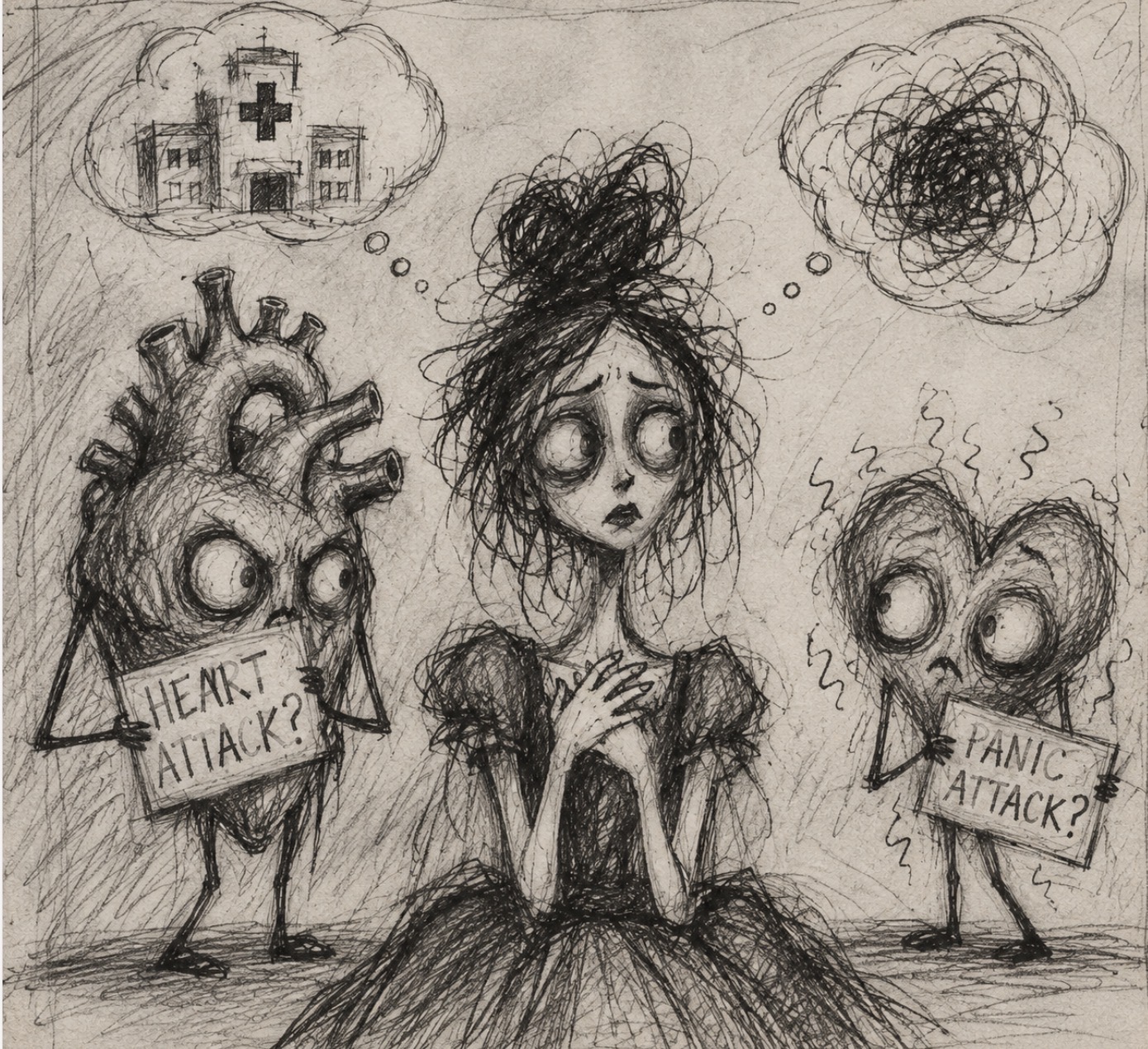
Your heart suddenly begins racing. Your chest tightens, your breathing feels restricted, and you become dizzy. Within seconds, a terrifying thought takes over: “Am I having a heart attack?” Understanding the difference between a panic attack vs heart attack can be difficult because both can produce intense physical symptoms. Chest pain, heart palpitations, shortness of breath, sweating, and nausea may occur in either situation.
For someone experiencing panic disorder, these sensations can trigger overwhelming fear. The more attention you pay to your heartbeat or breathing, the more frightening those sensations may become.
Although panic attacks themselves are not life-threatening, a heart attack is a medical emergency. Symptoms alone cannot reliably distinguish the two. If you experience new, unexplained, or potentially cardiac chest discomfort or other heart attack warning signs, call 911 rather than assuming anxiety is responsible.
Why Can a Panic Attack Feel Like a Heart Attack?
Panic attacks activate the body’s fight-or-flight response, a survival mechanism designed to prepare you for danger.
When your brain perceives a threat, the sympathetic nervous system activates. Stress hormones such as adrenaline increase your heart rate, alter your breathing, and prepare your muscles for action.
These changes can create physical sensations that resemble a cardiac emergency.To learn more about treatment with me visit my panic disorder and agoraphobia service page.
What Happens to Your Body During a Panic Attack?
During a panic attack, you may experience:
- Rapid or pounding heartbeat
- Chest tightness or discomfort
- Shortness of breath
- Dizziness or lightheadedness
- Sweating or trembling
- Tingling or numbness
- Nausea or stomach discomfort
- A terrifying feeling that something catastrophic is happening
These sensations are real physiological responses. They are not imagined or exaggerated.
Changes in breathing can also contribute to symptoms. Rapid breathing may lower carbon dioxide levels in the blood, producing dizziness, tingling, and additional chest discomfort.
The problem becomes more complicated when these sensations are interpreted as evidence of imminent danger.
For example, noticing a rapid heartbeat may lead to the thought, “My heart is beating too fast. Something must be wrong.”
That interpretation increases fear, which further activates the nervous system and intensifies the physical sensations.
This is one reason panic attacks can escalate so quickly.
Author of When Fear Shrinks Your World. An IllustratedGuide to Healing from Panic Disorder. Available on Amazon
Panic Attack vs Heart Attack: What Are the Key Differences?
The fundamental difference involves what is happening inside the body.
A heart attack occurs when blood flow to part of the heart muscle is severely reduced or blocked, potentially damaging the heart.
A panic attack involves an intense activation of the body’s fear response without the same underlying cardiac process.
However, heart attack symptoms vs panic attack symptoms can overlap considerably.
Symptoms That May Occur in Both Conditions
Both can involve:
- Chest pain or pressure
- Difficulty breathing
- Rapid heartbeat
- Sweating
- Nausea
- Dizziness
- A sense of impending doom
A panic attack often reaches peak intensity within minutes, while heart attack symptoms may develop suddenly or gradually.
However, duration is not a reliable way to distinguish the two. Heart attack symptoms can come and go, and panic symptoms may persist or recur.
Similarly, although panic attacks frequently occur during periods of stress, they can also happen unexpectedly while resting or sleeping.
A heart attack can occur at rest as well.
Warning Signs That Require Emergency Medical Attention
Potential heart attack symptoms include:
- Chest pressure, squeezing, fullness, or pain
- Discomfort spreading to the arm, shoulder, back, neck, or jaw
- Shortness of breath, with or without chest discomfort
- Cold sweats
- Nausea or vomiting
- Lightheadedness or unusual weakness
Women may also experience less obvious symptoms, including unusual fatigue, upper back discomfort, or nausea.
These symptoms do not always follow a predictable pattern.
If a heart attack is possible, seek emergency medical attention immediately. Do not use a symptom checklist, breathing exercise, or previous panic disorder diagnosis to rule it out.
Why Does Panic Attack Chest Pain Feel So Real?
One of the most frightening aspects of panic disorder is how convincing the physical symptoms can become.
Panic attack chest pain may result from muscle tension, changes in breathing, and heightened awareness of bodily sensations.
During intense anxiety, muscles surrounding the chest and shoulders may tighten. Breathing may become rapid or shallow, creating additional discomfort.
At the same time, attention becomes narrowly focused on physical sensations.
A heartbeat that would ordinarily go unnoticed suddenly feels unusually strong. A brief sensation in the chest may become impossible to ignore.
Understanding panic attack vs heart attack symptoms can help explain why anxiety-related physical sensations feel so frightening, even after a medical evaluation has ruled out a heart problem.
The Role of Catastrophic Misinterpretation
In cognitive behavioral therapy (CBT), catastrophic misinterpretation refers to interpreting an ambiguous sensation as evidence of serious danger.
For example:
You notice your heart beating rapidly.
You think, “This could be a heart attack.”
Fear increases.
Your heartbeat accelerates further.
You interpret the stronger heartbeat as confirmation that something dangerous is happening.
This creates a self-reinforcing cycle of physical sensations, frightening interpretations, and escalating anxiety.
Once appropriate medical evaluation has ruled out a cardiac cause for the symptoms being treated, CBT can help you understand and interrupt this cycle.
Why the Fear of Having a Heart Attack Can Maintain Panic Disorder
For some people, the most distressing part of panic disorder is not the initial attack but the ongoing fear that another one will happen.
You may begin monitoring your heartbeat throughout the day, avoiding exercise, checking your pulse, or repeatedly searching online for explanations of chest discomfort.
Some people avoid caffeine, stairs, crowded places, or activities that naturally increase their heart rate.
Others become afraid of being alone because they worry that nobody will help them if a medical emergency occurs.
These behaviors are understandable attempts to feel safe. However, after appropriate medical assessment, excessive checking and avoidance can unintentionally reinforce the belief that ordinary bodily sensations are dangerous. Read the article about Why panic Attacks Keep Happening.
When Reassurance Becomes Part of the Problem
You may visit a physician, receive reassuring results, and feel better temporarily.
Yet the next time your heart races, the same frightening question returns.
“What if something was missed?”
Repeated reassurance may reduce anxiety briefly without changing the underlying fear of bodily sensations.
This does not mean you should ignore new symptoms or avoid appropriate medical care. It means that once a medical concern has been properly evaluated, persistent anxiety may require a different kind of treatment.
The goal is to distinguish appropriate medical attention from repetitive reassurance-seeking driven by panic.
How CBT Helps With the Fear of Heart Attack Symptoms
Cognitive behavioral therapy is one of the most extensively studied psychological treatments for panic disorder.
Rather than simply teaching you to calm down during an attack, CBT addresses the interpretations and behaviors that maintain the fear.
Understanding the Panic Cycle
Treatment begins by examining the relationship between physical sensations, thoughts, anxiety, and behavior.
You learn to identify the moment an ordinary sensation becomes interpreted as catastrophic.
For example, the thought “My heart is racing, so I must be in danger” can be examined as an interpretation rather than automatically accepted as a fact.
This process helps reduce the tendency to treat every uncomfortable sensation as an emergency.
Interoceptive Exposure: Learning Not to Fear Bodily Sensations
Interoceptive exposure is an important component of CBT for panic disorder.
It involves deliberately and gradually experiencing feared physical sensations in a structured therapeutic setting.
Depending on medical history, individual suitability, and appropriate clearance, exercises might involve activities that temporarily increase heart rate or produce mild dizziness.
The objective is not to prove that every physical symptom is harmless.
Instead, after relevant medical concerns have been addressed, treatment helps individuals learn that familiar anxiety-related sensations do not always require avoidance, checking, or immediate attempts to eliminate them.
Over time, the sensations may become less threatening, reducing the cycle of fear and panic.
Reducing Safety Behaviors
Therapy may also address behaviors such as repeatedly checking your pulse, searching for reassurance, or avoiding activities because they increase your heartbeat.It may also address agoraphobia and fear of being in situations from which it would be difficult to escape in a situation of panic , such as planes, public transportation, crowded places, restaurants and so on.
Gradually reducing unnecessary safety behaviors can help rebuild confidence in your ability to experience physical discomfort without automatically interpreting it as catastrophe.
The focus is not on eliminating every uncomfortable sensation. It is on changing your relationship with those sensations.
Frequently Asked Questions About Panic Attacks and Heart Attacks
Can a Panic Attack Feel Exactly Like a Heart Attack?
Yes. A panic attack can produce symptoms that closely resemble those of a heart attack, including chest discomfort, sweating, nausea, and difficulty breathing.
Because the symptoms overlap, a medical assessment is necessary when a heart attack is possible. The intensity of fear or the presence of anxiety does not establish the cause.
How Can I Tell if Chest Pain Is From Anxiety?
Chest pain from anxiety may occur alongside intense fear, rapid breathing, muscle tension, or heart palpitations. However, these features cannot reliably rule out a heart problem.
New or unexplained chest pain requires medical evaluation, and possible heart attack symptoms warrant emergency care.
Can Anxiety Cause Chest Pain Even When I Feel Calm?
Yes. Anxiety-related physical sensations can occur without an obvious feeling of emotional distress. Panic attacks can also arise unexpectedly.
Nevertheless, chest pain should not automatically be attributed to anxiety simply because you have experienced panic attacks before.
Can Panic Disorder Be Treated Without Medication?
Many people benefit from CBT for panic disorder, including cognitive interventions, behavioral changes, and exposure-based techniques.
Medication may also be helpful, depending on symptom severity, personal preferences, and medical circumstances.
Treatment should be individualized rather than based on the assumption that everyone needs the same approach.
Panic Disorder Therapy in NYC: Breaking the Cycle of Fear
If you have received appropriate medical evaluation but continue to fear your heartbeat, chest sensations, or the possibility of another panic attack, therapy can help you address the cycle that keeps the anxiety going.
Understanding panic attack vs heart attack symptoms is an important starting point, but overcoming panic disorder often requires addressing the fear of bodily sensations themselves.
With evidence-based treatment, you can gradually reduce anticipatory anxiety, challenge catastrophic interpretations, and regain confidence in situations you may have started avoiding. Read this article to learn How to Choose a Therapy to Treat Panic Disorder and /or Agoraphobia
About Eliana Bonaguro, LMHC
I’m Eliana Bonaguro, a Licensed Mental Health Counselor in New York and Florida, specializing in cognitive behavioral therapy (CBT) for anxiety disorders, including panic disorder, agoraphobia, social anxiety, and obsessive-compulsive disorder (OCD).
I earned my Master of Science in Education in Clinical Mental Health Counseling from Hunter College’s CACREP-accredited program. My advanced professional training includes cognitive behavioral therapy through the Beck Institute, including specialized training in anxiety disorders.
My approach combines evidence-based CBT, Acceptance and Commitment Therapy (ACT), and exposure-based interventions. I focus on helping clients understand the psychological processes that maintain anxiety, challenge catastrophic interpretations, and gradually regain confidence in situations they have come to fear.
I provide individualized, collaborative treatment that goes beyond symptom management to address the patterns that keep panic and anxiety going.
Schedule a Free 15-Minute Consultation
If recurring panic attacks, fear of physical sensations, or anticipatory anxiety are interfering with your daily life, you don’t have to continue organizing your life around the possibility of another panic attack.
I offer a free 15-minute consultation to discuss your concerns, answer questions about my therapeutic approach, and determine whether working together would be a good fit.
I provide online therapy for adults throughout New York and Florida, including New York City.
Schedule your free 15-minute consultation
References
- National Institute of Mental Health — Panic Disorder: What You Need to Know
- American Heart Association — Warning Signs of a Heart Attack
- American Heart Association — How to Tell the Difference Between a Heart Attack and Panic Attack
This article is educational and is not a substitute for medical diagnosis or emergency care. If you suspect a heart attack, call 911 immediately.