Choosing the right therapist for panic disorder and agoraphobia can be difficult, especially when many therapists list “anxiety” among the conditions they treat. Panic disorder and agoraphobia have specific features that benefit from a therapist who understands panic attacks, fear of physical sensations, anticipatory anxiety, avoidance, and exposure-based treatment.
Perhaps you’ve already had medical evaluations and have been told that you’re healthy, yet the sensations still feel frightening. Your heart races and you wonder whether something is wrong. You feel dizzy in a store and immediately want to leave. You become short of breath while driving and start looking for the nearest exit.
Eventually, you may become frightened not only of panic attacks themselves but of where you might be when one happens.
This is where panic disorder can begin to change the way you live.
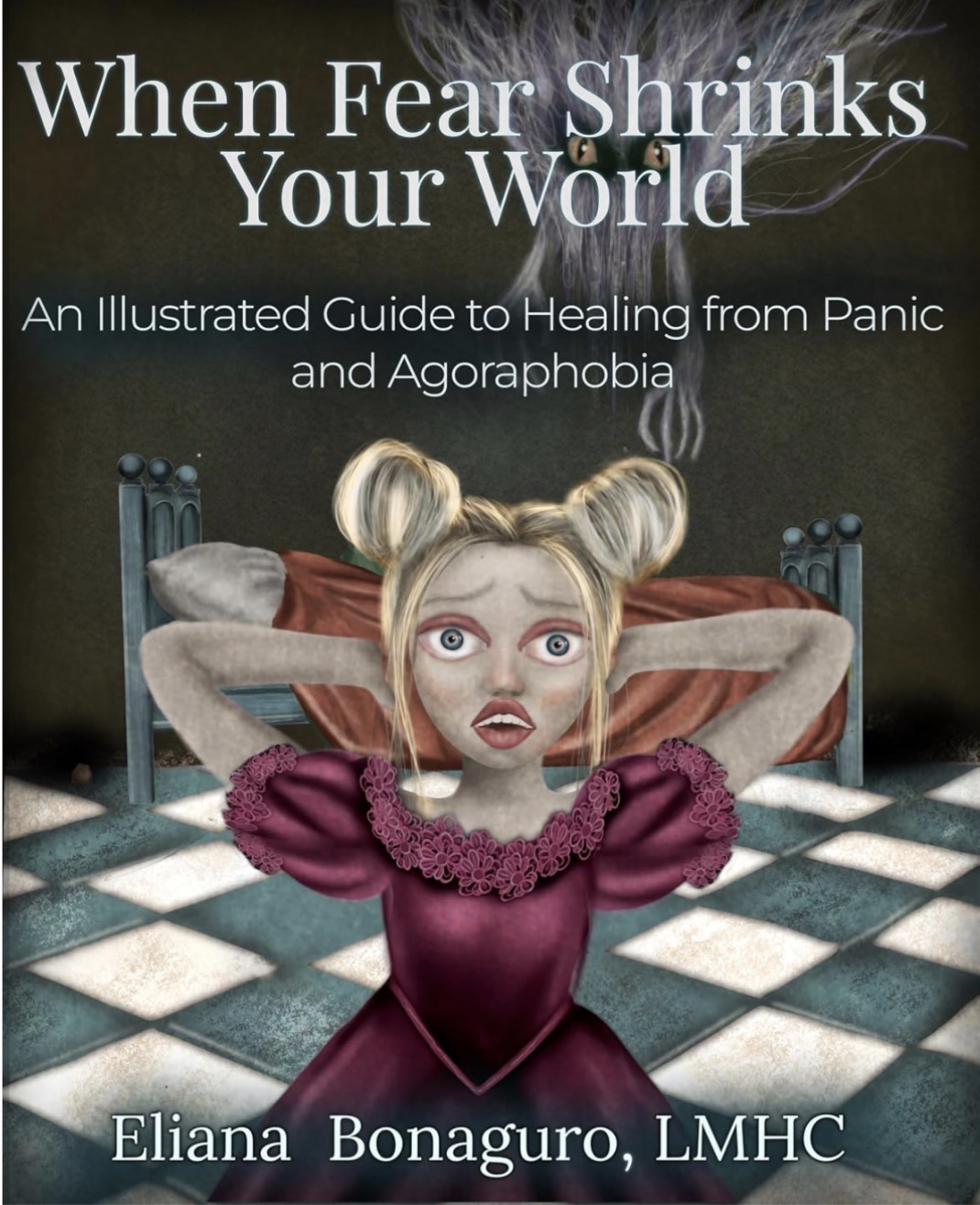
Author of When Fear Shrinks Your World: An illustrated Guide to Healing from Panic Disorder and Agoraphobia.
Why Panic Attacks Can Turn Into Panic Disorder
Many people experience a panic attack at some point. Panic disorder involves recurrent unexpected panic attacks followed by persistent concern about additional attacks or their consequences, or significant changes in behavior related to the attacks.
After a frightening panic attack, you may begin paying much closer attention to your body.
Was that heartbeat faster than usual?
Why am I dizzy?
Am I getting enough air?
What if I faint?
What if this feeling gets worse?
Normal changes in heart rate, breathing, temperature, balance, or other bodily sensations can begin to feel threatening. That fear increases physiological arousal, which can intensify the very sensations you are monitoring.
This can create a powerful fear-of-fear cycle.
An experienced panic disorder therapist should understand this cycle and know how to help you interrupt it.
Agoraphobia Can Shrink Your Life Without Keeping You Housebound
Agoraphobia is often misunderstood as simply being afraid to leave the house.
In reality, it involves fear and avoidance of situations in which escaping might feel difficult or help might not be readily available if intense anxiety or other distressing symptoms occur. Panic disorder and agoraphobia are separate diagnoses, although they frequently occur together.
Someone with agoraphobia may still go to work, shop, exercise, drive, or socialize.
But there may be increasingly complicated rules surrounding those activities.
You might drive, but avoid highways.
You be afraid of getting a panic attack on the NYC subway
You might shop, but only at stores close to home.
You might go to a restaurant, but prefer a seat near the exit.
You might travel, but only with someone you trust.
You might avoid elevators, airplanes, bridges, crowds, public transportation, long lines, unfamiliar places, or anywhere that feels difficult to leave.
When looking for a panic disorder therapist someone who understands these patterns rather than assuming that agoraphobia always means being housebound. Learn about panic disorder therapy in NYC and Florida here.
A knowledgeable agoraphobia therapist should also be interested in the conditions under which you can do things, not only the activities you avoid completely.
Your Therapist Should Understand the Fear-of-Fear Cycle
This is one of the first things I would want to know.
Effective panic treatment is not simply about learning how to relax during a panic attack.
A panic attack can become especially frightening when physical sensations are interpreted catastrophically. A racing heart may be interpreted as a heart attack. Dizziness may lead to fear of fainting. Feeling detached or unreal may be interpreted as losing control.
That interpretation creates more fear.
More fear creates additional physical arousal.
Those sensations then appear to confirm that something dangerous is happening.
CBT for panic disorder works directly with this relationship among physical sensations, interpretations, fear, and behavior.
A panic disorder therapist should be able to explain this cycle clearly and describe how treatment will target it.
When speaking with a prospective therapist, ask:
How do you conceptualize panic disorder, and what would we actually work on in treatment?
The answer should make sense to you.
Interoceptive Exposure: Learning Not to Fear Your Body
This is an especially important consideration when choosing a therapist for panic disorder and agoraphobia.
Interoceptive exposure is designed specifically to address fear of physical sensations.
Depending on a person’s symptoms and medical circumstances, exercises may intentionally produce sensations similar to those experienced during panic—for example, an increased heart rate or dizziness.
Why would you deliberately practice something you desperately want to stop experiencing?
Because the sensations themselves may have become conditioned signals of danger.
If every increase in heart rate triggers Something is wrong, you may begin avoiding anything that raises your heart rate: exercise, stairs, caffeine, sex, hot weather, or even excitement.
Interoceptive exposure provides opportunities to experience feared sensations differently and learn new information about them. Deliberately inducing feared but harmless bodily sensations is a form of exposure specifically used with panic disorder.
The exercises should be selected based on the individual’s particular panic symptoms, fears, health considerations, and treatment goals.
A panic and agoraphobia therapist should therefore individualize interoceptive exercises rather than simply giving every client the same exposure plan.
Effective Agoraphobia Treatment Must Address Avoidance
Treating panic symptoms alone may not address the ways someone’s life has gradually become restricted.
Agoraphobia often involves avoidance and escape.
Imagine that you experience intense panic while driving on the highway. The next day, you take local roads instead.
Your anxiety immediately decreases.
Naturally, taking local roads feels like the better choice.
But after repeatedly avoiding the highway, driving on it may begin to feel even more threatening. Perhaps eventually you avoid bridges as well. Then heavy traffic. Then unfamiliar roads. Eventually you are comfortable driving only within a few miles of home.
This is how avoidance can gradually make someone’s world smaller.
In-vivo exposure involves systematically approaching feared real-life situations rather than continuing to avoid them. Exposure is an established component of treatment for agoraphobic avoidance.
An agoraphobia therapist should help identify exactly what has become difficult for you and build treatment around your particular pattern of avoidance.
The Hidden Safety Behaviors That Keep Agoraphobia Going
Sometimes avoidance is easy to recognize.
“I haven’t taken the subway in two years.”
Other times it is much less obvious.
You may still do almost everything—but only under particular conditions.
Perhaps you can drive 20 minutes from home but not 40.
You can enter a crowded store but immediately leave if you become lightheaded.
You can fly if you take particular precautions beforehand.
You can attend an event as long as you know exactly where the exits are.
You can travel if someone else drives.
These details matter because they show the therapist where panic has begun influencing your choices.
A thorough assessment of panic disorder and agoraphobia should look not only at what you have stopped doing but at how you have modified activities because of fear.
A skilled panic and agoraphobia therapist should assess these less obvious patterns as carefully as complete avoidance.
Good Exposure Therapy Is Built Around What You Actually Fear
Exposure shouldn’t simply mean, “Go do something scary.”
Two people can avoid exactly the same situation for very different reasons.
Consider two people who avoid elevators.
One fears becoming dizzy and fainting.
The other fears experiencing a panic attack while the doors are closed and being unable to escape.
Their outward behavior looks identical. Their feared outcomes are different.
The same is true of driving, airplanes, stores, restaurants, crowds, exercise, public transportation, or being alone.
A therapist should understand what you predict will happen, which sensations frighten you, what you avoid, and how you respond when panic begins.
That information helps determine which interventions make sense for you.
What Effective Panic Disorder Treatment Looks Like
Although treatment should be individualized, CBT for panic disorder commonly includes several interconnected components.
You may learn how panic works physiologically and psychologically, identify the interpretations that intensify fear, practice experiencing feared bodily sensations through interoceptive exposure, and gradually approach situations you have been avoiding.
If agoraphobia is present, treatment may also involve increasingly approaching situations that have become restricted because of fear.
Panic-disorder CBT protocols commonly combine psychoeducation, monitoring of symptoms and avoidance, interoceptive exposure, and exposure to feared situations.
The purpose isn’t simply to endure anxiety until the session ends.
The work provides opportunities for the brain to learn something different about sensations and situations that have become associated with threat.
An experienced panic disorder therapist can adjust these components according to the fears, avoidance patterns, and goals of the individual.
Recovery from Panic Disorder Happens Outside the Therapy Session Too
Panic disorder and agoraphobia occur in everyday life, so much of the learning needs to happen there too.
Depending on your treatment plan, between-session practice might involve intentionally experiencing certain physical sensations or approaching situations you have been avoiding.
Someone might practice driving progressively farther from home.
Another person might return to exercising after avoiding an increased heart rate.
Someone else might practice staying in a store after noticing the first signs of anxiety rather than immediately leaving.
Regular practice is important because treatment is designed to change established patterns of fear and avoidance, not simply discuss them once a week.
Progress Means Getting Your Life Back, Not Never Feeling Panic
It is natural to measure recovery by asking:
How many panic attacks did I have this week?
That’s useful information, but it isn’t the only measure of progress.
I also look at what someone is able to do.
Are you driving farther?
Are you exercising again?
Can you stay in the grocery store when physical sensations appear?
Have you started using elevators again?
Can you tolerate traffic without immediately exiting the highway?
Are you traveling farther from home?
Are you returning to places you had stopped going?
One of the most meaningful signs of progress in agoraphobia is that your world begins expanding again.
How to Tell Whether a Panic Disorder Therapist Is the Right Fit
When you’re considering a therapist for panic disorder and agoraphobia, you might ask:
- How frequently do you treat panic disorder and agoraphobia?
- What treatment approach do you use?
- Do you use CBT for panic disorder?
- Do you use interoceptive exposure?
- How do you approach agoraphobic avoidance?
- Do you use in-vivo or real-life exposure?
- How do you decide which exposure exercises are appropriate?
- What should I expect to do between sessions?
- How will we measure whether treatment is working?
You don’t need the therapist to use exactly the same terminology you have read online.
What matters is whether they can clearly explain how their treatment addresses panic attacks, fear of physical sensations, anticipatory anxiety, and avoidance.
A panic disorder therapist should be able to give you a clearer answer than simply saying that they treat anxiety.
What to Look for in a Therapist for Panic Disorder and Agoraphobia
A strong therapeutic relationship matters, but panic disorder and agoraphobia also benefit from targeted treatment.
When choosing a therapist for panic disorder and agoraphobia, look for someone who understands the panic cycle and has experience using evidence-based strategies that address both feared bodily sensations and avoided situations.
If agoraphobic avoidance is a significant part of the problem, an experienced agoraphobia therapist should also understand how escape, safety behaviors, and increasingly restrictive rules can maintain fear.
Panic can make your life progressively smaller.
Treatment should help you reverse that direction.
Panic Disorder and Agoraphobia Treatment in New York and Panic disorder Treatment in Florida
About Eliana Bonaguro, LMHC: I am a Licensed Mental Health Counselor providing online therapy for adults with panic disorder and agoraphobia in New York and Florida. I received advanced trainign in anxiety disorder at the Beck Institute of Cognitive Behavioral Therapy and I am a member of the International OCD Foundation (IOCDF) I use CBT, interoceptive exposure, and individualized exposure strategies to address panic symptoms, fear of physical sensations, anticipatory anxiety, and agoraphobic avoidance.
As a panic and agoraphobia therapist, I individualize treatment according to the particular sensations, situations, predictions, avoidance patterns, and safety behaviors that have become part of the panic cycle.
I have also the book When Fear Shrinks Your World: a Visual Guide to Managing Panic Disorder and Agoraphobia and regularly provide therapy for panic disorder and agoraphobia in New York and panic disorder and agoraphobia treatment in Florida.
If panic attacks or fear of having another panic attack have begun affecting where you go, how far you travel, whether you drive, or what you feel comfortable doing, you can contact me to learn more about treatment and whether my approach is a good fit for you.
Pingback: Why Do Panic Attacks Keep Happening? Understanding the Panic Cycle and How to Break It Why Do Panic Attacks Keep Happening? Causes and Treatment - Eliana Bonaguro, LMHC