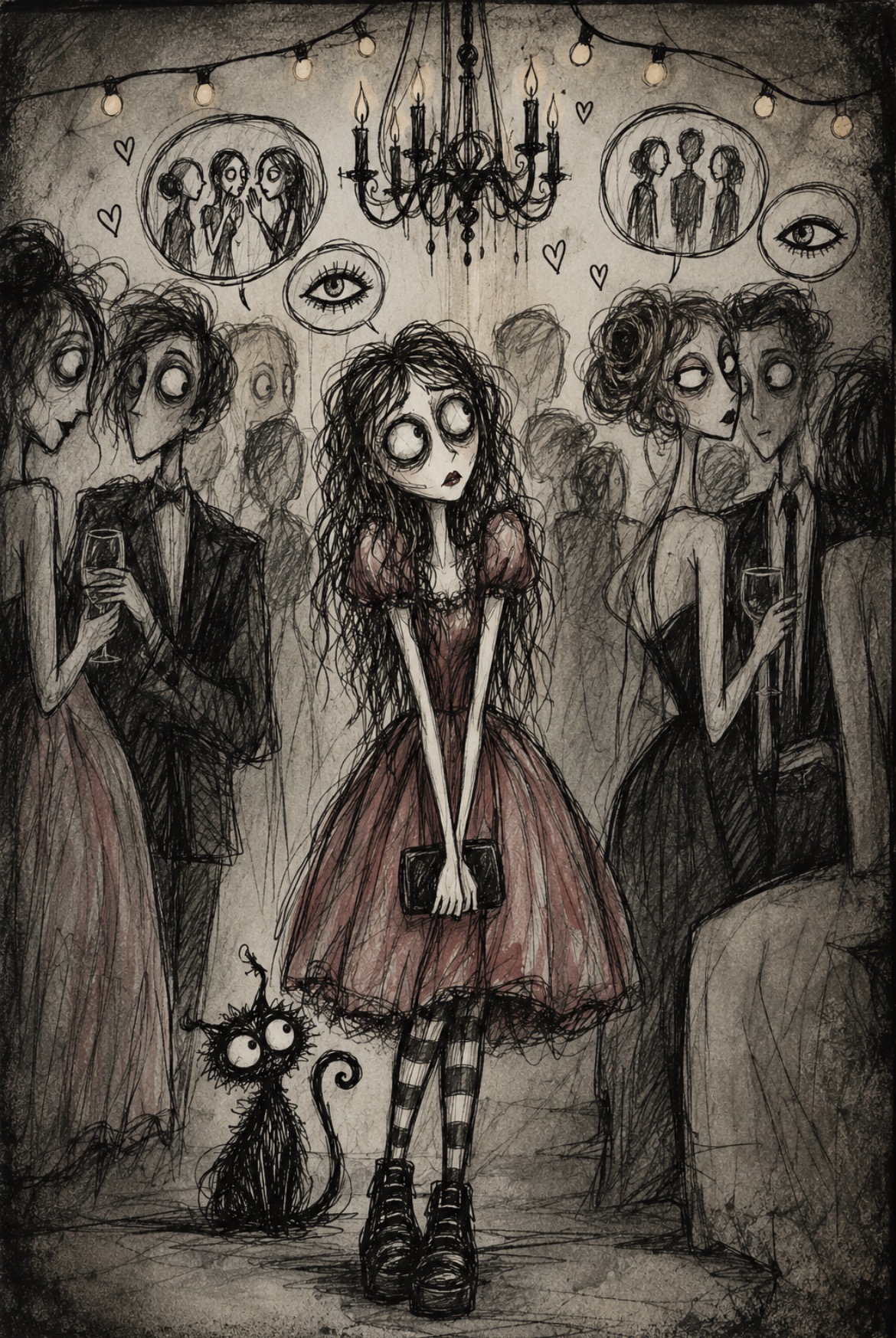
Social anxiety symptoms aren’t always as obvious as avoiding parties, public speaking, dates, or meeting new people. Sometimes you show up. You talk to people. Maybe you even look completely relaxed. But inside, you’re monitoring everything.
Am I talking too much? Was that weird? Where should I look? Do they notice I’m nervous?
Before you speak, you rehearse what you’re going to say. When the conversation gets uncomfortable, you check your phone. You stay close to the person you know. And when you finally get home, instead of feeling relieved, you replay the conversation looking for something you did wrong.These are some of the less obvious social anxiety disorder symptoms, because you may still be participating while anxiety quietly controls how you behave.
These less obvious signs of social anxiety can be easy to miss because, from the outside, you aren’t necessarily avoiding anything. You showed up. But anxiety may still be controlling how you show up.
Underneath many of these patterns is a fear of social judgment—the worry that other people will notice something awkward, embarrassing, or unacceptable about you.
Social anxiety disorder, historically called social phobia, involves more than avoiding uncomfortable situations. It can also involve subtle strategies designed to prevent embarrassment, rejection, awkwardness, or negative judgment.
In cognitive behavioral therapy (CBT), many of these strategies are called safety behaviors. They can provide short-term relief, but they can also prevent you from discovering that you can tolerate uncertainty, imperfection, and other people’s reactions without trying to control every interaction.
What Are the Symptoms of Social Anxiety?
Social anxiety symptoms can involve thoughts, emotions, physical sensations, avoidance, and behaviors designed to keep you from being judged or embarrassed.
You may worry excessively about what people think of you, fear saying something awkward, avoid eye contact, stay quiet in groups, or feel intensely self-conscious when attention is directed toward you. You may also experience physical symptoms such as blushing, sweating, trembling, nausea, or a racing heart.
But some signs are much subtler.
You might attend the party but spend the entire evening beside your closest friend. You might participate in a meeting but carefully rehearse everything before speaking. You might repeatedly check your phone so you never appear to be standing alone.
You’re technically facing the situation, but you’re doing it with protection.
This distinction matters because safety behaviors can reinforce the belief that the social situation really was dangerous.
Your mind may conclude:
I got through that because I barely spoke.
They didn’t think I was weird because I rehearsed everything first.
Nobody noticed how anxious I was because I hid it.
Instead of learning that you could handle the situation, you learn that you survived because you protected yourself.
Here are ten signs of social anxiety that can work this way.
10 Signs of Social Anxiety You May Not Recognize
1. Rehearsing Everything You’re Going to Say
A little preparation before an important conversation is normal. With social anxiety, however, rehearsal can become constant.
You may predict what someone will ask and prepare several possible answers. Before telling a story, you mentally organize it. You might even decide not to say something because you can’t figure out exactly how to phrase it.
Underneath the rehearsal is often a prediction:
If I say the wrong thing, they’ll think I’m stupid, awkward, boring, or strange.
Rehearsal creates a temporary feeling of control. But conversations aren’t scripts. Trying to perform them perfectly can pull your attention away from the person in front of you and make you even more self-conscious.
A behavioral experiment might involve saying something before you’ve completely worked out the wording and noticing what actually happens.
2. Carefully Managing Eye Contact
When fear of social judgment takes over, even something as automatic as eye contact can start to feel like a performance you have to get exactly right .Avoiding eye contact is commonly associated with social anxiety. But excessive management of eye contact can become a safety behavior too.
Am I staring?
Should I look away now?
Did I look away too quickly?
Suddenly, something that usually happens naturally becomes another performance you have to get right.
You aren’t simply talking anymore. You’re talking while simultaneously observing and evaluating yourself.
That intense self-focused attention can make social interactions much more exhausting.
3. Staying Quiet So You Can’t Say the Wrong Thing
You attend the meeting, dinner, class, or gathering but speak only when someone directly asks you something.
You may avoid telling stories, expressing opinions, making jokes, disagreeing, or introducing a new topic.
It makes sense from anxiety’s perspective: the less you say, the fewer opportunities you have to make a mistake.
But staying quiet can reinforce the idea that being noticed is dangerous.
Reducing social anxiety avoidance doesn’t mean becoming the loudest person in the room. It might mean deliberately making one comment you normally would have kept to yourself and allowing uncertainty about how other people receive it.
4.Using Your Phone to Cope With Social Anxiety
Phones provide an incredibly convenient escape from awkwardness.
Waiting alone? Check your phone.
Standing at a party while everyone else seems to be talking? Scroll.
Someone gets into the elevator? Look down.
There’s nothing inherently wrong with checking your phone. What matters is its function.
If you repeatedly reach for it because you don’t want to look alone, available for conversation, uncertain, or uncomfortable, your phone may have become a safety behavior.
A surprisingly useful exposure can be very small: stand in line or wait somewhere without taking out your phone.
You don’t have to start a conversation. You’re simply practicing being visibly unoccupied without trying to cover the discomfort.
5. Staying Close to a “Safe” Person
Another of the social anxiety symptoms and signs is being very nervous when a safe person is not close to us in social situations. Maybe you’ll attend the party, but only if your partner comes.
You’ll go to the networking event, but stay beside the coworker you know.
You’ll meet a group for dinner, but spend most of the evening talking to your closest friend.
From the outside, this looks like successful participation. You went.
But ask yourself:
Would I have gone without this person?
Support is valuable. The goal isn’t to stop relying on other people altogether. The problem develops when another person becomes a requirement for entering situations you actually want to navigate independently.
An exposure could involve attending together but separating for ten minutes, initiating one conversation alone, or eventually entering a familiar social situation without your usual safe person.
6. Asking Questions So Nobody Asks About You
Fear of social judgment can make revealing your opinions, interests, or preferences feel risky, so keeping the attention on someone else may feel safer.
This one can hide particularly well because asking questions is generally considered a good social skill.
You might become excellent at keeping another person talking.
Where are you from?
What do you do?
How long have you lived here?
What are you doing this weekend?
The conversation may appear to be going beautifully. But you’ve revealed almost nothing about yourself.
Why?
Because talking about yourself creates uncertainty.
Someone could disagree with your opinion. They might think your interests are boring. They might judge a decision you’ve made.
One goal in CBT for social anxiety can be practicing more balanced conversations: asking questions while also volunteering information, expressing preferences, and allowing yourself to be known.
7. Monitoring Your Face, Voice, Body, or Anxiety
Am I blushing?
Are my hands shaking?
Does my voice sound nervous?
What am I doing with my hands?
Do I look uncomfortable?
Self-monitoring is one of the less obvious social anxiety symptoms.
Instead of directing your attention toward the conversation, your environment, or the person in front of you, your attention turns inward.
You become both participant and critic.
And the more closely you monitor physical sensations, the more noticeable they can become.
Treatment can involve practicing shifting attention outward rather than continuously checking whether you appear anxious.
8.Planning Your Escape From Social Situations
You choose the chair closest to the door.
You drive separately so you can leave whenever you want.
Before an event begins, you decide exactly how long you’ll stay.
You avoid committing because you need the option to cancel at the last minute.
Having choices isn’t unhealthy. But when an escape plan becomes something you need in order to tolerate a social situation, it may reinforce anxiety.
A behavioral experiment could be sitting somewhere other than your usual safe seat, staying ten minutes longer than planned, or going somewhere without deciding in advance exactly when you’ll leave.
The goal isn’t to trap yourself. It’s to discover that discomfort can rise and fall without requiring immediate escape.
9. Trying to Hide Signs of Anxiety
For someone with a strong fear of social judgment, being visibly nervous may feel almost as threatening as the social situation itself.
Sometimes the fear isn’t simply:
I’m going to feel anxious.
It’s:
What if somebody notices?
You might hold something tightly to conceal shaking hands. Avoid holding a drink. Cover your face when you feel warm. Speak less because your voice might tremble. Carefully control your breathing.
These behaviors can strengthen the assumption that visible nervousness would be disastrous.
But what would actually happen if someone noticed?
Perhaps someone would notice and think nothing of it. Perhaps they wouldn’t notice at all. Perhaps you might never know what they thought.
That uncertainty is precisely what anxiety wants you to eliminate.
Exposure therapy for social anxiety can help you practice allowing some uncertainty rather than continually trying to make anxiety invisible.
10. Replaying Conversations After They End
The social interaction ended an hour ago.
Your mind is still there.
Why did I say that?
She looked away when I was talking.
I talked too much.
I didn’t talk enough.
That joke wasn’t funny.
He probably thinks I’m weird.
This pattern is often called post-event rumination or post-event processing. It is also one of the signs of social anxiety people may not immediately recognize.
Social anxiety is rarely an impartial reviewer.
A two-second pause becomes evidence that you were awkward. Someone checking their phone becomes evidence that you were boring. A neutral facial expression becomes evidence of rejection.
You may believe you’re analyzing the interaction so you can perform better next time. Instead, repeatedly reviewing perceived mistakes can strengthen your fear of the next interaction.
Why Do Social Anxiety Symptoms Keep the Cycle Going?
Imagine you have this belief:
If I speak without thinking carefully first, I’ll say something stupid, and people will judge me.
You go to dinner and rehearse almost everything before you say it.
Nothing terrible happens.
Your anxious mind now has two possible explanations:
Maybe I don’t actually need to control everything I say.
Or:
Thank God I rehearsed. Otherwise, I would have embarrassed myself.
If you always use the safety behavior, you may never get the opportunity to test the first possibility.
Now imagine gradually experimenting with speaking more spontaneously.
Sometimes conversations flow. Sometimes you stumble over your words. Sometimes you tell a story beautifully. Sometimes a joke falls flat.
In other words, you have human conversations.
The goal isn’t to prove that nobody will ever judge you. We can’t control other people’s opinions.
The goal is to learn that you don’t need complete control over other people’s reactions to participate in your own life.
Why Do I Overthink Conversations After Socializing?
Many people with social anxiety replay conversations after they end.
You may review what you said, how you looked, the other person’s facial expressions, pauses in the conversation, or whether you talked too much or too little.
This can feel productive because your mind tells you it is trying to determine whether the interaction went well.
But there is usually no definitive answer.
Someone looking away could mean they were bored. Or distracted. Or thinking. Or tired. Or absolutely nothing.
Trying to solve that uncertainty can turn an ordinary interaction into hours of analysis.
Learning to recognize post-event rumination and disengage from repeatedly reviewing the interaction can therefore become an important part of social anxiety treatment.
How CBT and Exposure Therapy Helps Social Anxiety
Understanding your particular social anxiety disorder symptoms helps us identify what is maintaining the anxiety rather than simply telling you to socialize more.In my work with social anxiety, I don’t simply tell people to “put themselves out there.”
We first identify what you believe will happen.
What are you afraid another person will notice? What would it mean if a conversation became awkward? What are you doing to prevent rejection or embarrassment? Where does your attention go while you’re interacting with someone?
Once we understand the cycle, treatment can become much more specific.
I integrate CBT for social anxiety, behavioral experiments, exposure-based strategies, and Acceptance and Commitment Therapy (ACT). Depending on your particular patterns, we might work on reducing excessive self-monitoring, dropping particular safety behaviors, approaching situations you’ve been avoiding, or deliberately allowing small amounts of imperfection.
That might mean:
- asking a question without rehearsing it first
- expressing an opinion someone could disagree with
- making small talk without evaluating yourself afterward
- allowing a pause in a conversation
- eating alone in public
- attending an event without remaining beside a safe person
- making a phone call instead of sending a message
- putting your phone away while waiting alone
- allowing yourself to appear slightly nervous
- saying something without later checking whether it sounded “right”
These aren’t random challenges designed to make you anxious.
A useful behavioral experiment has a purpose. We identify the prediction first, then create an opportunity to see what happens when you respond differently.
But What If Someone Really Does Judge Me?
This is an important question because therapy can’t promise that nobody will ever judge you.
People have opinions. Sometimes conversations really are awkward. Sometimes someone doesn’t respond the way we’d hoped.
Trying to guarantee that none of those things will happen is part of what can make social anxiety so restrictive.
Instead of asking:
How can I make sure nobody judges me?
You begin asking:
Can I tolerate not knowing exactly what someone thinks of me?
That shift matters.
You don’t need every interaction to go perfectly before you can date, make friends, speak during meetings, go to events, or express your personality.
Shouldn’t I Wait Until I Feel More Confident?
Social anxiety often tells you that confidence needs to come first.
When I’m more confident, I’ll start dating.
When I’m less anxious, I’ll speak during meetings.
When I stop caring what people think, I’ll make more friends.
But waiting for anxiety to disappear can keep life on hold.
Confidence often develops after repeated experiences of doing things imperfectly and discovering that you can handle the outcome.
You don’t need to become fearless. The goal is to develop enough flexibility to do things that matter while allowing anxiety to be present.
When Should I Get Help for Social Anxiety?
If social anxiety symptoms such as fear of judgment, self-monitoring, avoidance, or repeatedly overthinking social interactions are making your world smaller, treatment can help you understand and change the cycle.
Rather than simply forcing yourself to socialize more, therapy can help identify the predictions, rules, avoidance patterns, and protective behaviors that keep social anxiety going.
If you’re in New York and would like to learn more about working with me, visit my Social Anxiety Therapy in New York page.
The goal isn’t to turn you into someone else. It’s to help anxiety have less control over what you say yes to, how much of yourself you allow other people to see, and how you live your life.
Frequently Asked Questions About Social Anxiety
What are the most common symptoms of social anxiety?
Social anxiety can involve fear of being judged, rejected, embarrassed, or watched by others. People may avoid social situations, struggle with eye contact, remain quiet, rehearse conversations, experience physical anxiety symptoms, or repeatedly analyze interactions afterward. Mayo Clinic
Why do I replay conversations in my head after socializing?
Replaying conversations after a social interaction can be a form of post-event rumination. You may review what you said, how you appeared, and how others responded while searching for evidence that you made a mistake or were judged negatively. Reviewing perceived flaws after social situations is recognized as a feature associated with social anxiety. Mayo Clinic
Why do I overthink everything I say after a conversation?
Social anxiety can make ambiguous social information feel significant. A pause, facial expression, or ordinary comment can become something to analyze repeatedly. Although overthinking may feel like an attempt to determine whether the interaction went well, it can keep your attention focused on possible mistakes.
Is social phobia the same as social anxiety disorder?
Yes. Social phobia is the older term commonly used for social anxiety disorder. Cleveland Clinic
How does CBT help with social anxiety?
CBT can help identify anxious predictions, self-focused attention, avoidance, and safety behaviors that maintain the anxiety cycle. Behavioral experiments and exposure-based strategies can then provide opportunities to test those predictions and practice responding differently.
Can you have social anxiety even if you don’t avoid social situations?
Yes. Someone may attend social events, meetings, dates, or other situations while experiencing significant anxiety or relying on protective behaviors such as rehearsing, remaining quiet, staying near a familiar person, or trying to hide signs of nervousness. The NHS CBT-based guide, for example, identifies staying quiet, always having someone with you, and attempts to hide anxiety among patterns associated with social anxiety. NHS Inform
Getting Help for Social Anxiety
If social anxiety symptoms are affecting your relationships, work, dating, or everyday life, you don’t have to keep organizing your life around anxiety. Treatment can help you understand the patterns keeping the cycle going and practice responding differently. If you’re in New York, learn more about my Social Anxiety Therapy in New York and schedule a consultation.
About Eliana Bonaguro, MSEd, LMHC
Eliana Bonaguro is a licensed mental health counselor in New York and Florida specializing in OCD and anxiety disorders, including social anxiety, panic disorder, and agoraphobia. Her approach integrates CBT, exposure-based strategies, ACT, and other evidence-based approaches while tailoring treatment to the individual rather than applying the same protocol to everyone.
Eliana Bonaguro’s professional training includes specialized cognitive behavioral therapy training through the Beck Institute for Cognitive Behavior Therapy, and I draw on continuing professional education and resources from organizations including the International OCD Foundation (IOCDF).
Eliana Bonaguro, LMHC also the author of books on anxiety, OCD, panic, relationships, and emotional well-being. You can explore her anxiety and mental health books on Amazon.